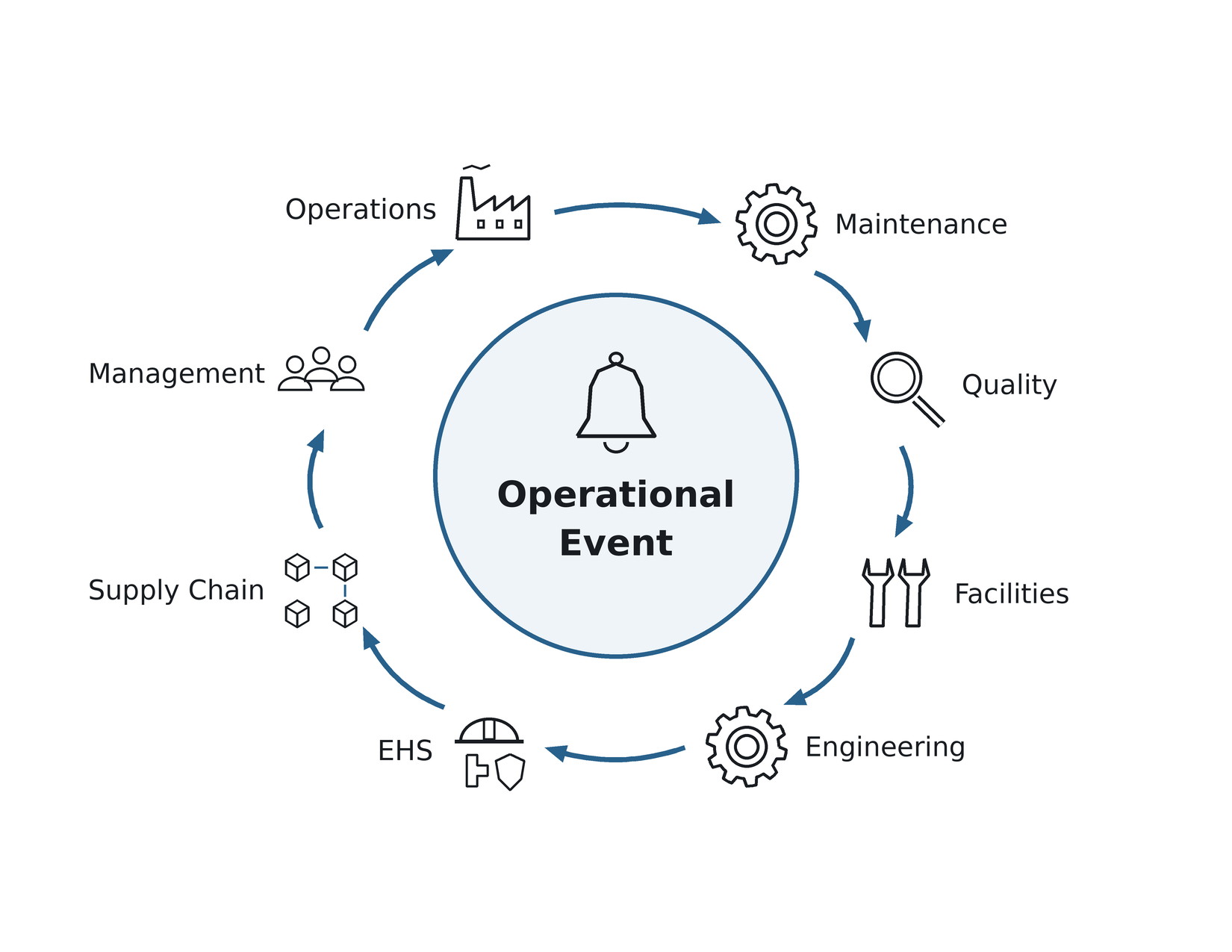


Operational events are typically recorded with outcomes after they’ve been addressed, but how do you know if you are responding as consistently and effectively as possible? Most companies don’t know. Long-time MES integrator IPG would argue that operational response management is a key capability that most software solutions and internal processes don’t measure or ensure. So, they created BackStaff, a software solution that helps organizations respond to operational events and anomalies in a coordinated, consistent, effective, and measurable way. It works alongside MES, LIMS, ERP, CMMS, QMS, and other systems of record.
Operational Response Excellence (ORE)
Responding to the unexpected is a competence that matters but is rarely defined or measured. Drawing on nearly three decades of experience implementing MES and manufacturing technology across different industries, processes, and operational environments, Luis Golcher, IPG’s Owner and Leader, began to recognize a recurring gap. While manufacturers had increasingly sophisticated systems for managing production and recording outcomes, the organizational response between detection and formal resolution remained largely unmanaged and unmeasured. While everyone responds to issues and crises, the consistency and effectiveness of these responses are typically neither cultivated nor structured and are rarely measured. He calls the missing capability Operational Response Excellence (ORE) and advocates adding it as a capability that leaders must manage.
His definition is: “Operational Response Excellence governs, measures, evaluates, and improves organizational response capability.” There’s an eight-part structure that describes it. This set of elements can enhance traceability and continuous improvement:
1. Notification
2. Routing
3. Escalation
4. Assessment
5. Coordination
6. Execution and Evidence
7. Documentation
8. Knowledge Capture
These aren’t required to flow in that order, as many situations call for working in parallel, or possibly doubling back. Yet it organizes this inevitable process into specific, visible, individually measurable pieces. Coordination is central, as it’s connected to everything and is often where responses break down in complex environments. Together, these eight foundational capabilities constitute organizational Response Capability. It is central to enabling work cells and cross-functional tiers to resolve operational events consistently and effectively, escalate when necessary, bring in the appropriate expertise, and document who did what and why in a traceable timeline that supports future learning and knowledge reuse.

Getting to Key Questions
Golcher discussed key questions that most companies cannot answer across the board in their Operational Response Excellence, and often cannot answer easily for a specific event. The questions revolve around who, when, how much, the fit of the response to the event, coordination, decisions and their rationale, impact, and learnings. Ad hoc responses via radio, email, phone, ticketing systems, Teams, or Slack often face constant interruptions and fragmented communication, which can divert the process and either leave the response incomplete or leave people unsure how well the response to an event actually went.

BackStaff Response Software
IPG set out to develop software to help people improve their response to each event. As the image at the top of this post shows, BackStaff can sit in a sidebar on the screen, so a frontline employee can still use their core application on the main screen and see alerts and event status, or manually create an operational event. It is also available as a mobile app for companies that provide mobile devices to their employees.
The goal is a system that looks like familiar mobile applications to users and is clear with minimal explanation. Users can download it from Google Play or the Apple App Store. Once downloaded, a manufacturer can configure blocks to represent operational events, which can be triggered manually or by signals from systems such as MES, SCADA, LIMS, and other operational applications or data sources.
A critical element is that when an event triggers, the system asks to identify an owner (and it might suggest one). It also supports adding context in the form of files, images, or other attachments to provide immediate context for the event. Events move through stages:
- open, when no one has addressed it
- ongoing, when the event is being addressed
- closed, after the event outcome is logged.
Each event in BackStaff becomes a focused channel for operational response.
Complements Current Systems
Operational Response Excellence does not replace but rather complements current disciplines such as Lean or Six Sigma, as well as other systems of record such as QMS, MES, LIMS, CMMS, EHS, etc. Realizing that, BackStaff has clear boundaries around where it operates and how it interfaces to receive event signals and push information back out to systems of record.
Event detection is common – there are event notification systems on the market. However, the other seven capabilities are not as common. Having each event generate a response record independent of the outcome record could really help in understanding where a company is weak or strong in managing unexpected events.

Our Take
These conversations got us thinking about what we do and don’t measure, manage, and focus on in operations. We know of some systems that support certain elements of operational response, but BackStaff seems to have a strong structure for owning, managing, and recording event response details. IPG seems to be respected as a trusted advisor by its customers in Latin America, and the company’s deep operations experience bodes well for BackStaff to accompany other systems. Initial customers are already using BackStaff. Since events are an inevitable part of a complex operation, this software is likely to see use every shift, and the operations team could begin to rely on it.
The potential business value includes shorter disruption duration, reduced operational impact, more consistent and effective execution, a greater reuse of organizational knowledge, a supporting timeline record for the domain of record, and a set of Response Capability KPIs to improve over time.
Thank You
Thank you, Luis Golcher, for taking the time to reach out and explain your vision for this missing capability of Operational Response Excellence to Rick Franzosa and me. We look forward to learning more as you share the vision and roll BackStaff out to more manufacturers and industrial operations.