
 Welcome to AI 2025 (pun intended)
Tech-Clarity had the opportunity to attend Autodesk University, now known simply as AU, in Nashville this year. AU 2025 was a large event with a lot of fanfare and excitement from Autodesk customers, partners, employees, analysts, and press. It’s always a great time to reconnect with Autodesk executives and product leaders to understand their strategy and hear from their customers about how using Autodesk products is working for them.
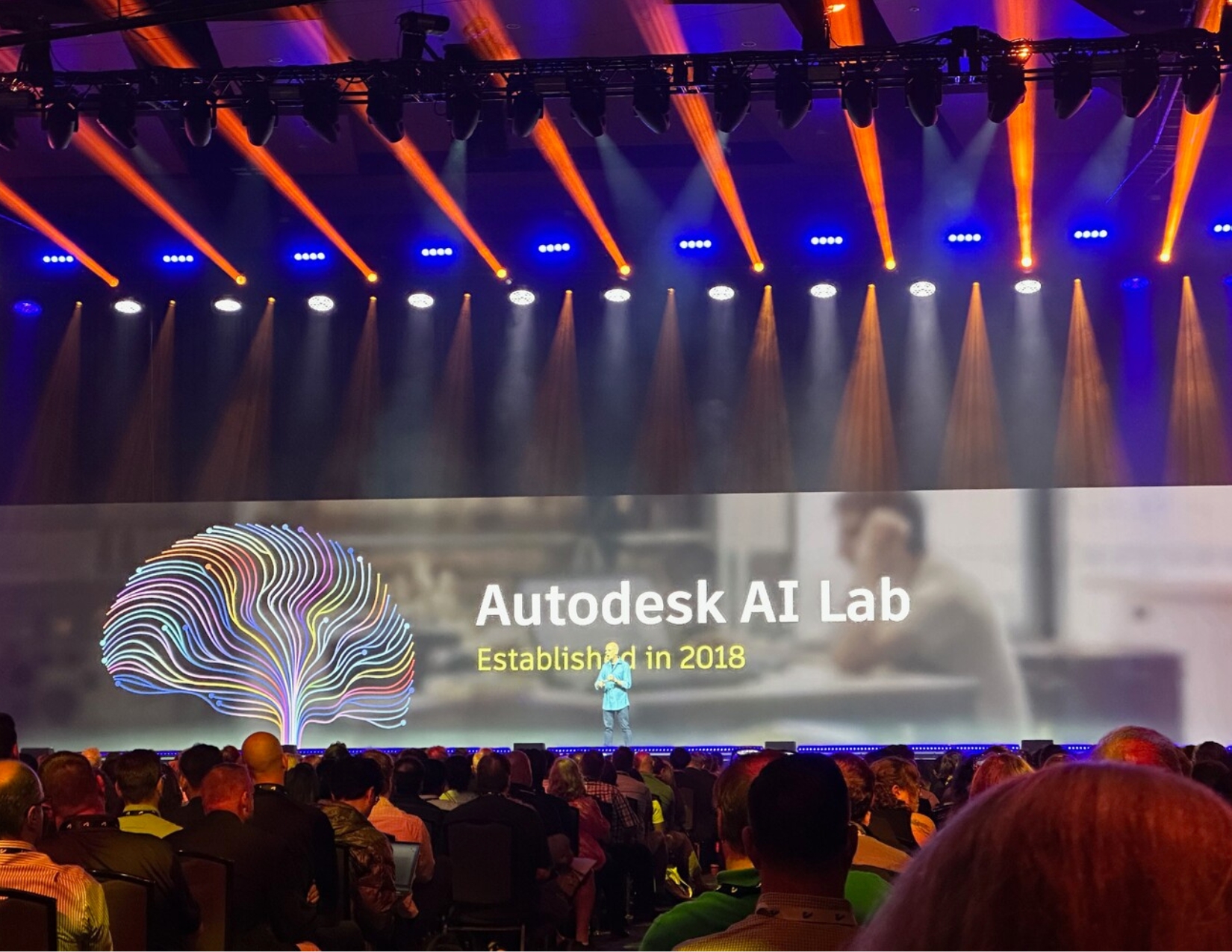
Nashville is the home of country music, but this week AI was on the center stage, as it was at the prior AU. One thing was different. Last year the audience listened to news about AI. This year, many came to hear about it. Autodesk CTO Raji Arasu’s AI Keynote was packed and people were taking notes. Companies know they need to pay attention to understand AI opportunities.
Significant Investment in AI
We titled our recap of AU 2024 as Autodesk University 2024 Focuses on AI, Platform, Core Products, and more AI. In the spirit of all things AI, we asked ChatGPT to summarize our post from last year, and it said, “Autodesk is making AI a core platform capability to automate routine work, assist designers, and speed innovation through integrated, scalable tools.” AI was the key takeaway of the multiday conference, according to AI. There was more, as the title shares, but the emphasis was on Autodesk’s AI efforts.
Following that, it didn’t seem likely that AI could gain any more focus at AU than they did last year. But it did. Autodesk CEO Andrew Anagnost focused the opening keynote primarily on how AI is transforming what they do and how their customers will work with their solutions. It was more than talk or generalities. Andrew brought up product leaders from all three of the industries they serve and showed tangible, valuable ways AI can add value by solving real problems.

Autodesk is not just researching AI technology, they’re focused on how it improves the way their customers work. When Andrew was asked what sets the Autodesk agentic AI solution, Autodesk Assistant, apart from others he shared that they are not adding a generic tool, but instead adding a layer on top of their solutions that takes into account the context of what application the user is using and what they’re doing. Autodesk’s AI agents will be specific about what they can do, not just try to be able to do anything. We agree with the practical approach because it helps customers get moving with AI quickly without having to do all of the learning and experimentation themselves.
Beyond Bernini
In parallel with the practical applications, Autodesk is investing heavily in core research. They created an AI Lab team with dedicated AI experts since 2018. Since then, Raji Arasu’s shares that they have developed patents and published over 90 AI research papers, and she claims that Autodesk is the leading publisher in AI for CAD, design, and geometry. From what we’ve seen, that is far more than others have invested.

This year, Autodesk shared a lot of AI progress. Last year we learned about Project Bernini, Autodesk’s R&D effort into AI for 3D shape creation. It turns out that Bernini was one of several foundation models that the Autodesk AI Lab was investing in. Autodesk is doing something unique. They are creating foundation models for 3D, as a corollary to the large language models (LLMs) that fuel AI giants like ChatGPT. Most of the research has gone into the detailed aspects of geometry like constraints and attachment points to precisely control models. The result is professional-grade foundation models for 2D and 3D. Their strategy is to have a hierarchy of AI models (see graphic) that starts with LLMs and concludes with industry specific models that understand 3D, CAD, physics, and event behavior. Following that will be customer specific models that can incorporate and apply detailed company knowledge.

They also shared significant advances with Autodesk Assistant. They learned from their early investments in AI assistants and now have a uniform assistant that is consistent across products. As mentioned earlier, one of the key benefits is that it maintains context. I expect we will see more from Autodesk from their agentic AI investments as they learn to leverage generally available LLMs and further exploit Autodesk’s foundation models.
Introducing Neural CAD
Autodesk has been investing in generative design from the early days. Now, they are taking that to the next level with what they call “Neural CAD” leveraging “Neural Technology.” This is the applied result of Autodesk’s modeling expertise, early investments in generative design, and their recent research into 2D and 3D AI foundation models. Neural CAD models are different because the foundation models are trained on how people design, not from an LLM.
The result is the ability to leverage GenAI foundation models to generate editable CAD objects with sketch and text prompts, which Autodesk says is a world first. This may very well be true. As compared with typical generative design models, the result is not just a 3D shape but true CAD geometry, a “first class citizen.” Neural CAD not only generates a solution, it creates the history and sequence of Fusion commands needed to create it. This way it can be modified like any other CAD model. Neural CAD will be available in Fusion and support Fusion BOMs, parts, and assemblies.

Raji Arasu shared the significance of Neural CAD. She explained that we need to rethink CAD engines, and compared it to moving from combustion engines to electric drive. She says the future of CAD engines is dynamic, adaptive systems that create editable geometry. It’s a bold vision, and Autodesk has taken significant strides in that direction.
AI in Design and Manufacturing
In addition to general AI announcements, we heard specific examples applicable to the manufacturing industry. Autodesk’s Executive Vice President for Design and Manufacturing, Jeff Kinder, explained Autodesk’s AI strategy for manufacturing. The first phase, he explained, is task automation. The second phase will be workflow automation, and the final phase is planned to be systems automation. Autodesk has big plans and a structured approach to introducing AI into their solutions.
Vice President of Design & Manufacturing Product Development Stephen Hooper shared specific examples of agentic AI capabilities focused on solving practical issues. The examples ranged from Fusion integration with Microsoft Office to address common, time-consuming challenges like preparing data for design reviews to more complex examples including applying a machining template to a new part.
Some of the other examples shared include bringing AI to Alias Form Explorer to aid with conceptual design by learning a brand’s “design language” and applying AI to aerodynamics. In Fusion, he mentioned exploring potential starting points for a design from prompts and creating CAD models you can work from, likely referencing Neural CAD. Other examples included auto dimensioning and tolerancing and automating 2D drawings with annotations. He also shared examples aimed at unifying factory and production solutions. The commonality in these examples is that they solve specific, practical challenges in design and manufacturing.
Investment in the Autodesk Platform and Industry Capabilities
Autodesk has been making strides across all its primary industries, AECO (Architecture, Engineering, Construction, and Operations), Media & Entertainment, and Design & Manufacturing. At the core of each of these is the Autodesk Platform, and the expression of these is an “industry cloud.” As Andrew shared the industry clouds are a new codebase but the work with the tools of today and the tools of tomorrow. Further, he explained, that “AI is native to industry clouds.”
Autodesk is investing in all of their industry clouds. They shared developments that help cut time and effort in developing media content like movies and television shows. They also highlighted their continued move to bring project management and BIM into the Autodesk Construction Cloud to create the central repository for infrastructure projects.

The industry cloud for Design & Manufacturing is Fusion. Autodesk continues to invest in the Fusion platform to make it a more complete offering. We’ve been impressed over time with their vision for an end-to-end solution that embraces openness and the granular data approach. Over time, we expect to see Autodesk customers migrate from existing solutions like Inventor and Vault to Fusion.
Investment in Design and Manufacturing
One of the most interesting developments this year is the announcement about the Manufacturing Data Model. It’s the culmination of investments to bring product digital thread data from all of Autodesk’s products into a common ontology. It’s intended to be open and extensible so manufacturers can connect data from the many other applications with Autodesk-generated digital thread data. Autodesk announced that product lifecycle data is now part of Fusion, that all of the manufacturing data is available in the graph database, and that there are APIs for Fusion, Vault, and Inventor. Srinath Jonnalagadda, Vice President of Data Management for Design and Manufacturing, explained that Vault Data and Fusion are now available through Autodesk Platform Services in the form of Fusion granular data APIs. This is an important step toward a unified Fusion solution. This has big implications for Autodesk customers and partners, opening up integration and extensibility of Fusion applications.
Overall, data and integration were key focus points for design and manufacturing. They announced integration between Fusion and Vault, Autodesk’s proven product data management (PDM) solution, bringing Autodesk’s PLM (product lifecycle management) and PDM data together. This is an important step forward for Autodesk customers that want to have product development and other product-related processes integrated with their product design data prior to moving fully to Fusion. This connection will become increasingly seamless as Fusion matures.

The PLM Summit
Once again AU was home to the PLM Summit, bringing together customers of Autodesk’s PLM solutions. It was a collaborative session, as usual, with manufacturers and Autodesk partners sharing their successes and challenges with each other to help everyone improve. Our two key takeaways are represented in the following pictures.
1 – The way Autodesk customers use Fusion PLM is varied based on their needs. This is a testament to the flexibility of the solution. This panel hosted by Michael Vesperman included four companies and each shared the different ways they use Autodesk PLM solutions.

2 – Fusion PLM is not just for simple companies. Bridgestone explained how they support standardized processes across multiple, global locations. This chart helps describe the level of complexity of their PLM processes supported by Autodesk.

It will be interesting to watch as Fusion Manage supports more PDM capabilities and rivals the functionality in their mature PDM solution, Vault, in a more integral fashion with broader process management and enterprise PLM capabilities. Our eyes are on Autodesk to see their continued development and maturation in PLM.
Our Take
Autodesk clearly believes the key to differentiation and success in the future is AI. Clearly, AI is upending a lot of existing solution paradigms. At the same time, however, they are working to make their core products and industry clouds better at meeting customers’ functional needs. Autodesk has a significant advantage in AI, particularly in the 3D AI space, as a result of their significant R&D investments. Time will tell how much that translates to future success, but if Autodesk is right, they are getting a significant head start on their competition that will be hard to match.
Thank You
Thank you Autodesk for including us in AU 2025, it’s always a pleasure to learn about what’s happening in Autodesk and the Autodesk ecosystem.