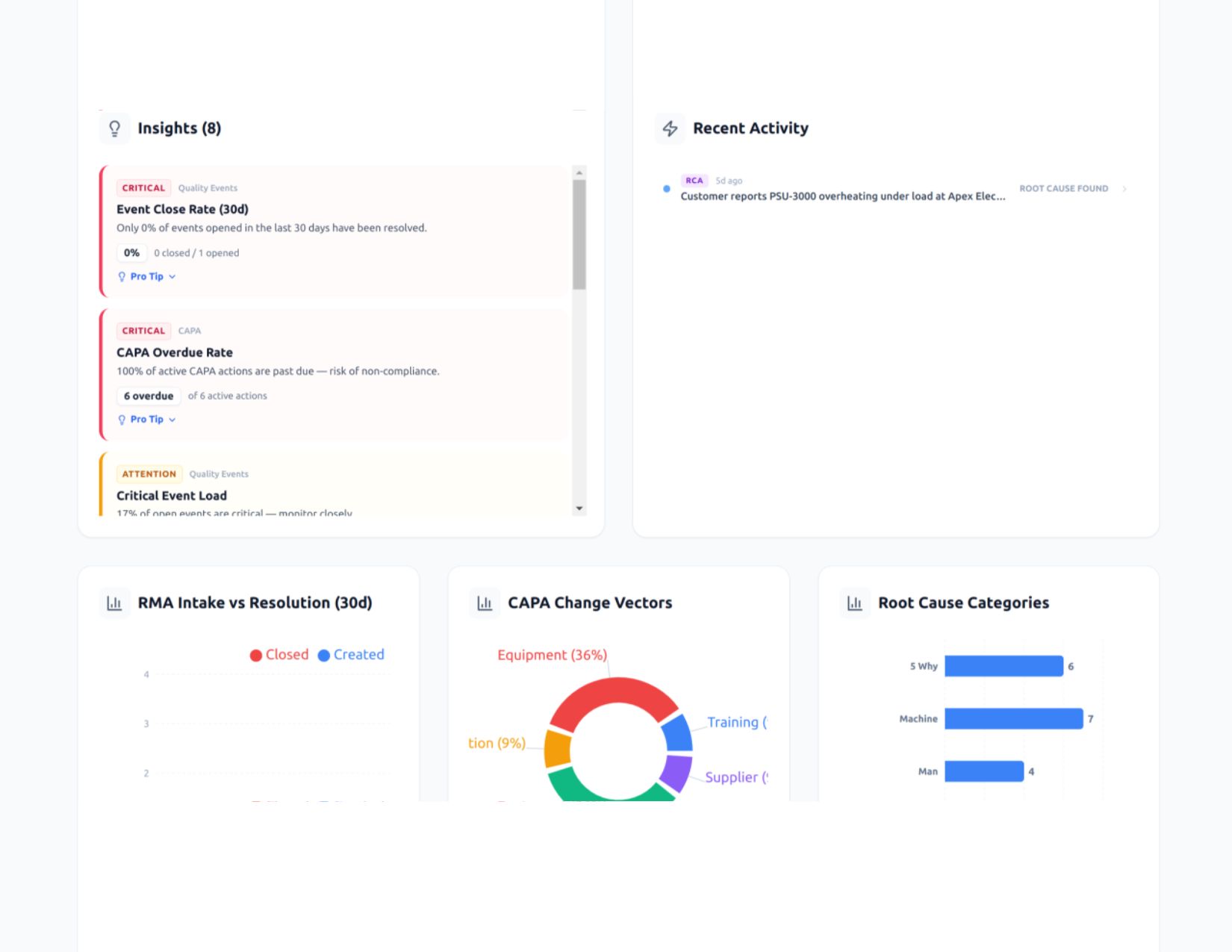


Why do audits continue to find problems after appropriate root cause analysis (RCA) and corrective and preventative actions (CAPA) processes are complete? MetaFloor AI argues that there is a missing capability to capture and consistently reuse causal data for process intelligence. Their AI-based platform uses a causal graph with AI to not only capture process standards and details of actual events, improvement processes, and outcomes, but also store and leverage them as codified institutional knowledge.
MetaFloor AI Offering
The platform this young company has developed has many capabilities:
- Process management incident ticketing
- Custom workflows for each process for a specific type of event that log, assign, and coordinate with people, and generate reports
- Industry-specific workflow templates that match known standards and common approaches
- Push a single button to start a workflow, such as a customer complaint, return material authorization, non-conformance record, or those to resolve the issues, such as RCA, CAPA, supplier corrective action request (SCAR), etc.
- Natural language (NL) AI-based basic and advanced queries that replace search and can find all relevant chains and detect what is relevant, designed to speed work for engineers and auditors
- Packet libraries to follow the complete flow of processes, such as CAPA
- Industry-tuned recommendations for action that become even more highly tuned to the company over time
- Document control with automated versioning and approval flows
- Change management and change impact mapping
- Compliance scoring against the company’s standard operating procedures (SOPs) that are detailed enough to identify gaps and proactively plan for upcoming audits

Typed Causal Governance
It is one thing to have formal processes for customer complaint handling, return materials authorization, and process non-conformance; that’s common. It is rare to be confident that the desired outcomes are complete. It is nearly unheard of to achieve that level of certainty in a rapid, automated fashion. This is where a causal graph and very precise process definitions come into play.
MetaFloor AI founders argue: “Standards-bound operational work is not fundamentally a document problem and not merely a generic workflow problem. It is a problem of preserving valid causal structure under uncertainty, coordination cost, and partial visibility. I don’t have the space to explain it all here, but the founders’ vision and fully documented formulas for typed causal governance are convincing. With this approach, it becomes clear when a case can safely be closed or when there are other dependencies to resolve.

Target Customers and Users
While every manufacturer might face these issues, MetaFloor AI’s initial customers are in the electronics industry. The company is also focused on aerospace & defense (A&D), automotive, and medical devices. These industries have both industry regulations and standards, as well as company-specific standards for production processes. MetaFloor AI’s custom workflows are designed for each industry, and they anticipate an 80% fit once they have created the workflow for a few customers in that industry and the model is trained.
Users tend to be process engineers, quality engineers, operational excellence, or continuous improvement (CI) professionals. These are typically the employees tasked with day-to-day incident management. The AI can pull together knowledge and past experience from all these people and projects, identifying where a current situation might be similar to past events.

Market Approach
The MetaFloor AI platform is designed to be self-serve. A customer can sign up and without consulting or integration up front, start with an incident to record. The system will prompt about that event and also request previous RCA reports. Building the knowledge base happens incrementally with each problem the team brings to the system, providing an always value-adding, low-friction adoption path.
To encourage use, MetaFloor AI has bundled everything into a monthly price. For $499/month, a company can get a manager seat with all three system layers and 100 events per month. The second user is free to further encourage companies to learn and spur greater use and compliance easily and quickly.
Founder Background
The company was founded in the fall of 2025 and is just getting off the ground. However, the idea took hold earlier. The founding team spent months refining the thesis and validating the problem with operators in regulated manufacturing before MetaFloor AI was officially launched. The founders each bring particular strengths to this venture. This is the third startup CEO and commercial leader Anup Mehta has founded; previous ones include DeepEdge and Clarice Technologies. Sridhar Perepa is COO and has worked in engineering across the electronics, life sciences, transportation, and aeronautics sectors. Arun CS Kumar is Head of AI and Product, and also heads AI for DeepEdge; he has a PhD in AI/computer vision and a background in perception engineering for autonomous driving.
Our Take
Closing the loop to ensure process improvements take place is not easy, but this AI- and industry-based approach holds great promise. The platform’s deep capabilities, combined with industry focus, bundled, cost-effective pricing, and NL interaction, bode well for growing adoption.
Thank You
Thank you, Anup, Arun, and Sridhar, for briefing me on your breakthrough concept and sharing your white paper on Typed Causal Governance. I look forward to following MetaFloor AI’s progress in the market!