

Makersite Delivers Product Lifecycle Intelligence (PLI)
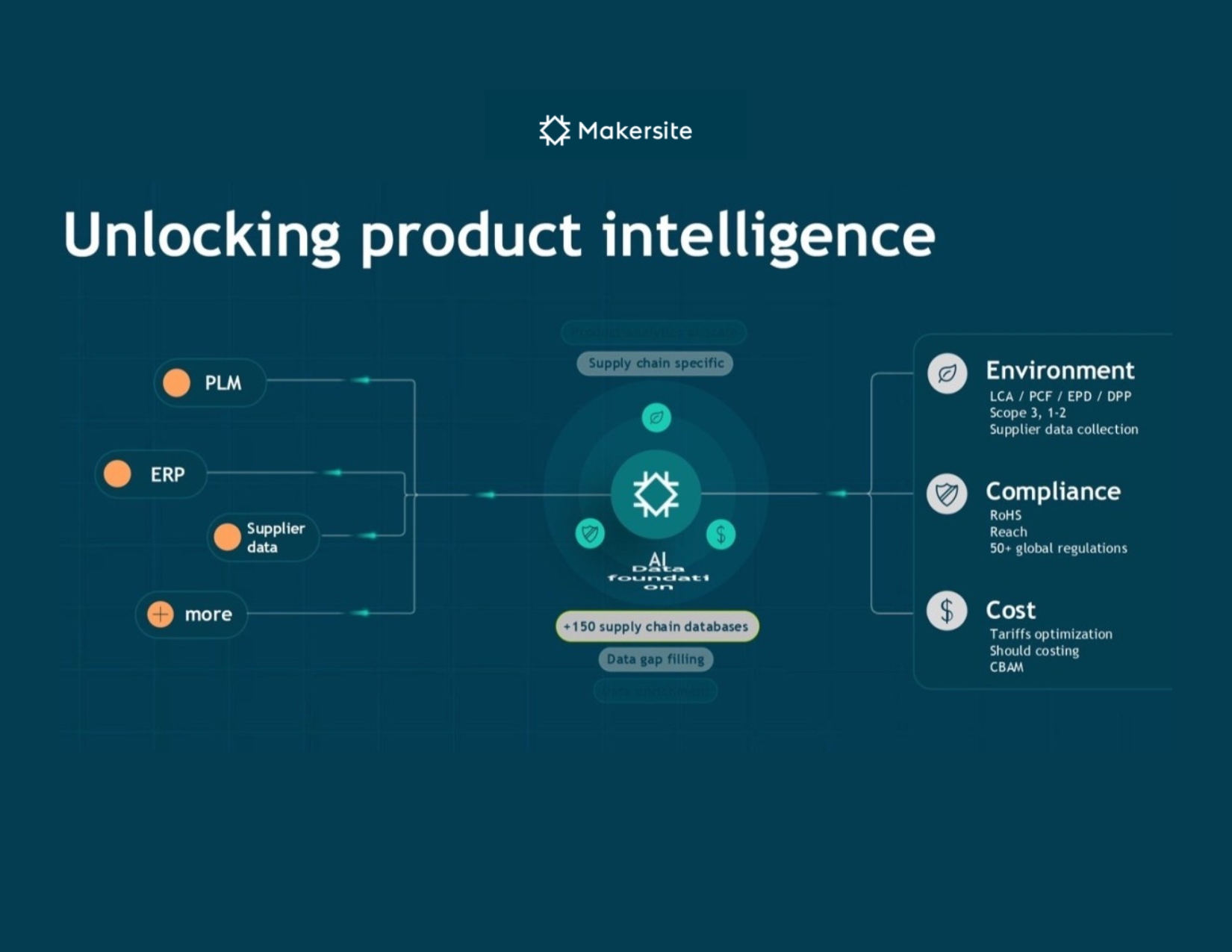
We have been impressed with Makersite and their focus on Product Lifecycle Intelligence (PLI), as we shared in our earlier briefing insight. Makersite is a small company that has big customers, and they’re helping those companies make significant gains on compliance, cost, sustainability, and supply chain risk. Their #PLI approach connects product data across design, supply chain, compliance, cost, and sustainability to create digital models that help manufacturers make better product decisions throughout the lifecycle. It’s a valuable offering to help companies get the data they need for designers to make better, more holistic decisions around components. The company offers more than applications, they provide data from a variety of sources – both internal and external – including over 150 Makersite gathered database.

Makersite Leverages Capabilities to Add More Value
Now, Makersite focuses on helping manufacturers “source smarter, design greener, and collaborate faster” by leveraging their AI-powered PLI for sustainable product and supply chain decisions at scale. There’s a lot to that, so let’s unpack what it means. Makersite had already gone beyond focusing solely on carbon content to help manufacturers design for sustainability. This is critical to long-term business success, as show in our Executive Strategies for Long-Term Business Success research series. Makersite is continuing down this path and extending their scope, leveraging their structured product model (aka digital twin) capabilities to collect and associate data with other critical impacts of design decisions including cost. Recently, they also announced they have acquired SiGREEN from Siemens Digital Industries Software and rebranded the platform as Mattermaps, strengthening their product data collection and exchange capabilities.
Costing
The big news is that Makersite is adding a “should cost” capability. It’s a new feature to evaluate costs at the portfolio level based on the digital twin, for example accounting for which components are going up in price. The solution is intended to help with scenario and what-if planning to help optimize decisions amid market disruption and uncertainty, which our study on long-term success show has been growing steadily over the last 5 years.
The solution complements others on the market because it more focused on purchased components, not for custom components that have to be evaluated at the 3D / CAD level detail. This makes the Makersite should cost approach complementary to feature-centric costing capability covered by other companies that address Product Cost Management (#PCM), such as aPriori or Facton. The Makersite methodology takes advantage of their strength in understanding the supply chain, and focuses across the product portfolio as opposed to a particular part or part family. We see the value of these solutions as additive, acting on different kinds of parts and at different levels of granularity. Makersite has added a very valuable capability to help manufacturers make better decisions that directly impact competitiveness and profitability.
Expanding AI Capabilities, Going Agentic
In addition to the should cost, and supporting it, are now agentic AI capabilities. AI is not new to Makersite. AI has been an important part of their solution for some time. As we said before, it’s important to understand the role artificial intelligence (#AI) and machine learning (#ML) play in Makersite’s ability to create a contextually rich digital thread mapping. Makersite refers to their platform capabilities as “AI powered Product Lifecycle Intelligence.” These capabilities were more embedded in the solution and behind the scenes. Now that they are expanding the use of AI Agents. The strength leverages their structured product model and offers mapping agents, modeling agents, and reporting agents. Makersite explains that the results, unlike some AI solutions, are grounded in data and traceable. The approach leverages AI but keeps a human in the loop for verification. It’s a practical approach that leverages their past AI experience to improve the value they deliver.
AI Application Example
One example of how the agents can add value is through a new offering, ChemAI. We were able to see a demo of how it works. ChemAI generates a product model for a chemical when suitable chemical data is limited or can’t be found in existing datasets. It uses available chemical information and AI to infer likely synthesis pathways and raw materials. This provides a foundation to determine sustainability, cost, and compliance where rich chemical datasets are unavailable. Then, the user can review and validate the results, and select the most appropriate synthesis pathway for that chemical. From my understanding, ChemAI helps fill chemical data gaps by inferring a recipe, raw materials, and associated impacts (see demo image).

Makersite ensures they are not just turning to AI and trusting answers. The solution creates a model by working upstream and connecting with existing data where available. It generates a variety of suggestions for how it was produced for the user to pick from. As a byproduct, the process develops a validated model that can be reused for future scenarios.
ChemAI is just one example of Maketsite’s plans, there will be others released, with plastics and metals mentioned as applications we could expect them to deliver at some point in the near future.
Customer Success
One of the things that has always impressed us is the Makersite customer list. They shared two published case studies during the briefing, each showing impressive results, including:
- Enabling Microsoft to allow engineers to evaluate carbon impact during design with 28% carbon reduction on Surface Pro 10 with 70% primary data
- Helping Lenovo develop configuration-level modeling across the ThinkPAD range, creating carbon transparency to develop ISO-aligned Product Carbon Footprint (PCFs)
Our Take
Makersite is expanding on already strong capabilities in their PLI offering. The two case studies reflect Makersite’s strong capabilities in sustainability, and we look forward to seeing more success stories around cost and supply chain risk as they expand their offering and use of AI. We are excited to following their continued success.
Thank You
Thank you Nicolás Artímez Wetz and Kerrie Kennedy for your time and for sharing your solution plans and customer successes.