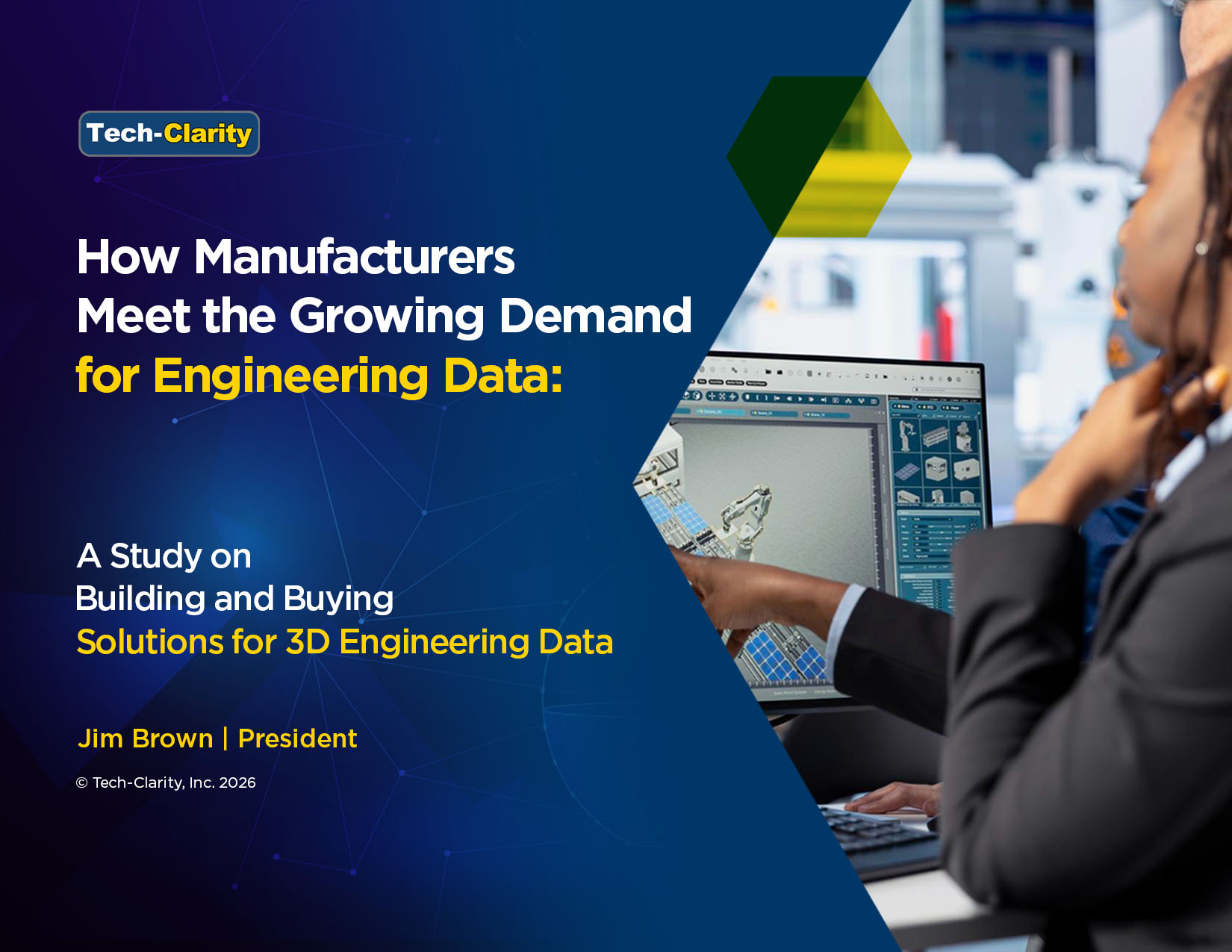

 Engineering data is valuable across the enterprise, but not everybody gets the information they need. We researched the need for 3D engineering data and the applications that create, access, and share it. We found the need is growing and investigated how companies are filling it. It’s not just the typical build-or-buy scenario.
Please enjoy the summary below. For the full research, please visit Tech Soft 3D (registration required).
Table of Contents
- Meeting the Demand for 3D and Engineering Data
- Meeting Demand for 3D Applications
- Engineering Application Challenges
- It’s Not Build or Buy
- How Companies Choose
- When to Build
- When to Buy
- Examples of When to Build and When to Buy
- Looking Forward
- The Evolution of Building and Buying with AI
- Recommendations
- About the Research
- Acknowledgments
Meeting the Demand for 3D and Engineering Data
Importance of 3D Data
 Designing in 3D has transformed product development, unlocking new value by supporting design and simulation techniques that reflect the real world. But the value of 3D data goes beyond making engineering decisions. It’s become the language to share and collaborate on product designs across the value chain. 3D engineering data has become a strategic business asset, powering downstream functions like manufacturing and service and serving as the backbone for high-value digital twins and AI initiatives.
Demand for 3D is Expanding
We recently interviewed 15 large manufacturing companies to better understand their need for applications that leverage 3D engineering data, the challenges they face, and how they source these solutions. The participants are quoted throughout this research.
More than two-thirds of respondents said the need to access and leverage 3D data across their company is growing, and the rest said it has stayed the same. Not a single company said that the need for 3D data had decreased.
Why is demand increasing? Respondents shared the following reasons:
- Innovation speed
- More complex products
- Leveraging 3D data downstream
- Collaboration across formats
- Integrating simulation tools
- Developing digital twins
Further, 3D data is becoming increasingly important to support new value from AI initiatives. AI is also making it easier for companies to develop new applications where 3D engineering data could improve performance and decision-making.
Meeting the Demand
Engineering leaders and IT need to extend the value of 3D CAD and simulation data across the digital thread, enterprise, product lifecycle, and supply chain.
They’re tasked with getting more value by sharing 3D engineering data:
- Inbound from suppliers
- Within engineering
- Downstream to manufacturing, service, and others
How can they best meet the demand for applications that create, access, and share 3D engineering data? Should they build their own, internal, custom applications or buy commercially available tools? The study sheds light on when to build and when to buy solutions.
It’s Not Build or Buy
When to Build, When to Buy
With all of these challenges, how do companies choose when to build and when to buy? The interviewed companies shared how they approach the decision.
Build and Buy
The research finds that it’s not an “all-or-nothing” decision. Only one company said they don’t consider both options. The vast majority keep both options available, and all but that one will build applications to fill needs. The default approach, however, tends to be buying a solution. All of the companies we spoke with (100%) prefer to buy their 3D-related solutions when there are solutions available.
That preference came through in the percentage of solutions they choose to build and buy. The average across the 15 companies we researched was 78% of solutions bought and 22% built.
The median was close to this as well, at 80%. Most companies we interviewed, in fact, hover around building solutions 20 to 25% of the time and buying the rest. But it varied by company; several were up to 40% in building solutions, while a few were at only 10% or said building is “very rare.” For most, they are complementary, not conflicting approaches.
The Decision isn’t Static
Most companies indicate a trend toward a commercial, off-the-shelf (COTS) approach in recent times. As one participant shared, “Originally I would say probably 75 percent was built and 25 percent bought, and now it’s opposite.” Given that most are seeking COTS, we expected to see a pervasive trend towards more commercial software. However, that isn’t always the case. Another company reported, “Commercial software does not meet our needs, and those needs have increased in the last three or four years. We were maybe 10% non-commercial software, and now we have around 30%. Whether that will continue to grow or stabilize or go down, I don’t know, but right now the trend is up.”
While some are shifting the balance one way or the other, the key takeaway is that most companies we spoke with operate in a hybrid environment.
Recommendations
Choose Based on Needs
 The need for applications that create, access, and share 3D data is expanding. It’s important to recognize that not every need will be met with commercially available solutions. To meet their needs effectively, companies must be open to both building and buying solutions as needed. Companies must consider speed and cost when they choose when to build and when to buy, of course. But they shouldn’t forget the often-overlooked cost of scaling. Further, they must be careful with needs that could reveal IP or sensitive data. Lastly, companies should recognize that AI may make building more accessible and more attractive, which may lead to a change in the current COTS-heavy balance of when to build and when to buy.
Don’t Start from Scratch
The expertise required to accurately interpret and exchange 3D engineering data is specialized, and resources are scarce. Engineering data, including 3D CAD and simulation data, is complex. Whether building or buying, it’s important not to start from scratch and reinvent the wheel.
When building solutions, companies should look for the opportunity to leverage components, SDKs, and building blocks. They should favor solutions that incorporate an understanding of how CAD works, including the complex mathematical representations behind the geometry and the rich metadata in the files. With the rise of AI vibe coding, less experienced developers may be looking for ways to access and share 3D data as well. These components may make this feasible. It may also make it feasible for them to create 3D data, but that is more complicated and less likely in the near term, although everything with AI is changing rapidly.
Choose a Strategic Partner
Look for trusted suppliers for both build and buy approaches. Look for proven, scalable apps with APIs to access multiformat CAD and simulation data. If creating 3D data, be careful to create the data as the designer or software provider would in order to ensure data quality.
Be Prepared to Change
Lastly, engineering and IT are always changing, and AI is accelerating the process. Recognize that the current process for deciding when to build and when to buy may need to evolve.
*This summary is an abbreviated version of the ebook and does not contain the full content. For the full research, please visit Tech Soft 3D (registration required).
If you have difficulty obtaining a copy of the research, please contact us.