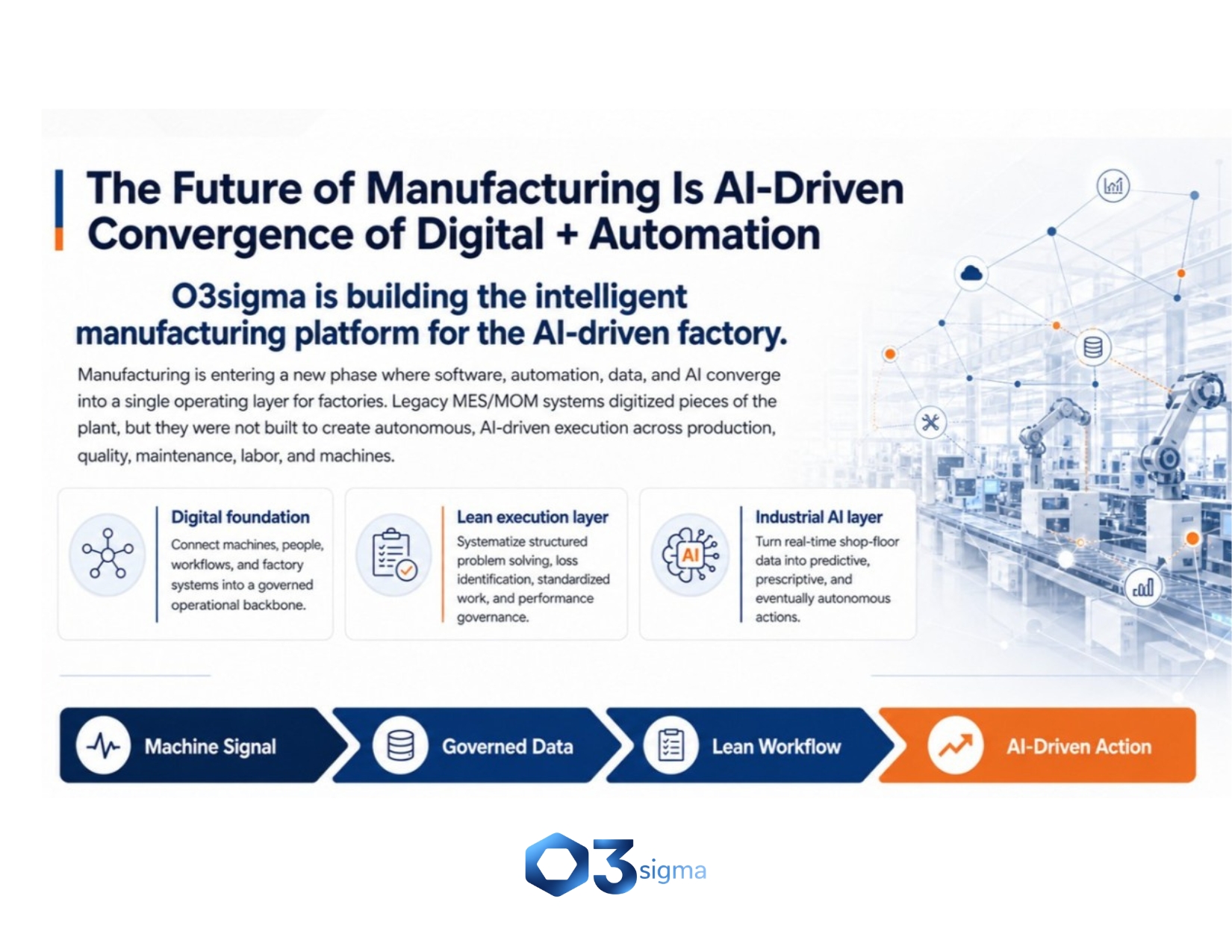


What happens when industry veterans join in commercializing an incubator-developed CPG MES? We sat down with the management team at O3sigma to learn about their history and plans for this enticing new offering in the CPG MES arena.
Born in CPG
The origins of O3sigma trace back to Obeikan Investment Group. This Saudi-based enterprise failed to realize the promise of MES in its packaging plants, with less-than-successful implementations of a solutions from a couple of well-known MES vendors. They turned to their internal ‘incubator’, Obeikan Digital Solutions, and formed a team of manufacturing engineering experts to build their own MES for high-volume CPG production using lean concepts.
The result was a solution that delivered respectable, repeatable savings for the Obeikan factories. They claim customers consistently achieve an average improvement of 15 points in Overall Equipment Effectiveness (OEE), with an annualized return on investment of over 500 percent. Obeikan decided that this offering was a great candidate for commercialization. They assembled a management team, consisting mostly of executives who had worked together at Infora decade earlier, including two who were lured out of retirement. The commercial entity, O3sigma, was born.
The Industrial Planes
The system is defined by an architecture consisting of five planes, not the Purdue model, but a set of planes that build from physical shop-floor actions to intelligence. The goal is to go beyond simple connectivity.
The first plane is the physical plane, the actual shop floor where people and machines work together to produce a product. The second plane is the Industrial DataOps plane, where data from every action on the shop floor is captured with fidelity and genealogy. Next is the control plane, where industrial data points are converted into virtual objects to build a generalized model-based on a global ontology.

This becomes the framework for the process plane, the home for apps, and the orchestration of workflows that deliver value to the workforce. The fifth plane is the intelligence layer, where O3sigma’s Industrial Composite & Foundation Models enable high-end simulation and analytics.
This freemium, open-source system includes 256 PLC drivers, digital twin libraries, a shared ontology, semantic contracts, governance, and interoperability. This architecture enables the implementation of agents, workflows, and composable solutions. By using a global ontology and virtual objects, the system aims to create a generalized model that ensures broad portability across various industrial applications.
The key is not in the five planes; it lies in the depth of the connection among them. In the view of O3sigma, smart manufacturing projects fail because implementors pay insufficient attention to this vertical connectivity.
Real-time Coordination and Ontology

This inventive industrial plane model appears highly adaptable and flexible, capable of handling high-speed, high-volume manufacturing processes. In the real world, a single PLC transaction could affect the operator’s co-pilot, the process engineer, the production manager, the quality engineer, and the routing, all in real time.
Coordinating tens of thousands of transactions from the plant is a daunting task. They have adopted an approach that defines a set of ontologies. This approach allows different constituencies to make decisions and take specific actions based on how the data or event affects their individual responsibilities. In effect, this takes the lofty and sometimes contentious ‘one version of the truth’ aspirations and turns them into actionable insights by interpreting the data in the context in which it is being evaluated.
AI and Predictive Maintenance Strategy
O3sigma CEO Tarik Taman stated in this briefing that “predictive maintenance is the substrate of AI.” This has also been reflected in our own research, “Making Manufacturing Analytics and AI Matter.” In this research, the manufacturing technologies with the highest adoption rates in GenAI were APM/CMMS and IIoT Platforms (where the most common industrial use cases are in predictive maintenance).

With a nod to Meta’s Chief AI Scientist, Yann LeCun, who was quoted as saying, “Building agentic systems on LLMs is a recipe for disaster,” O3sigma’s approach to adopting AI in manufacturing is to limit the role of LLMs to interpretation of natural language processing and to focus its AI efforts on physics, numerical methods, and neurosymbolic AI, supported by their graph neural network (GNN), O3-GNN. O3 reports that their O3-GNN recently achieved the best published accuracy on NASA’s C-MAPSS turbofan degradation benchmark — considered by some as the gold standard for predictive maintenance evaluation since 2008.
O3-GNN is built on RelationalAI’s GNN framework, which runs natively on Snowflake. This approach eliminates the need for separate ML infrastructure.
Future Directions – Vertical Frontier AI
O3sigma is very optimistic about their ambitious goal of joining the race to create the world’s first industrial foundation models built from primitives. They are racing with other companies to see who can generalize instructions for controlling a machine. In the world of physics, this race is about understanding and generalizing processes, the behavior of components down to the physics level, and the relationships between them.
This means you need generalized knowledge of everything at the atomic level, compose that knowledge to answer questions, and determine the next best action by persona. This is a gargantuan task. It requires the ability to parse 10 million transactions per second and tell what’s happening from quality, maintenance, and production perspectives. Only then can the workforce be informed about what everybody should do before, during, and after.
It all starts with their original ontology, a lean taxonomy. They are digitally mapping all of their corporate and parent companies’ assets, one SOP at a time. This task will take a long time, but they believe they are building great assets.
O3sigma provides the MES core “forever free.” Access to more powerful analytics and AI tools is a premium feature that customers can add to their implementation when they are ready. As O3sigma continues to add manufacturing sites to its customer base, it is working to encourage freemium customers to contribute their libraries and hierarchies to the O3sigma community library, making the community asset more valuable to both existing and new customers as the customer base grows.
Thank You
Thank you, Tarik Taman, Matt Grabow, Marius Blass, Fouad TOUMERT, and John Bermudez, for the detailed briefing for Rick Franzosa and Julie Fraser. We thoroughly enjoyed learning about your company and look forward to our next update as O3sigma expands into the North American market.