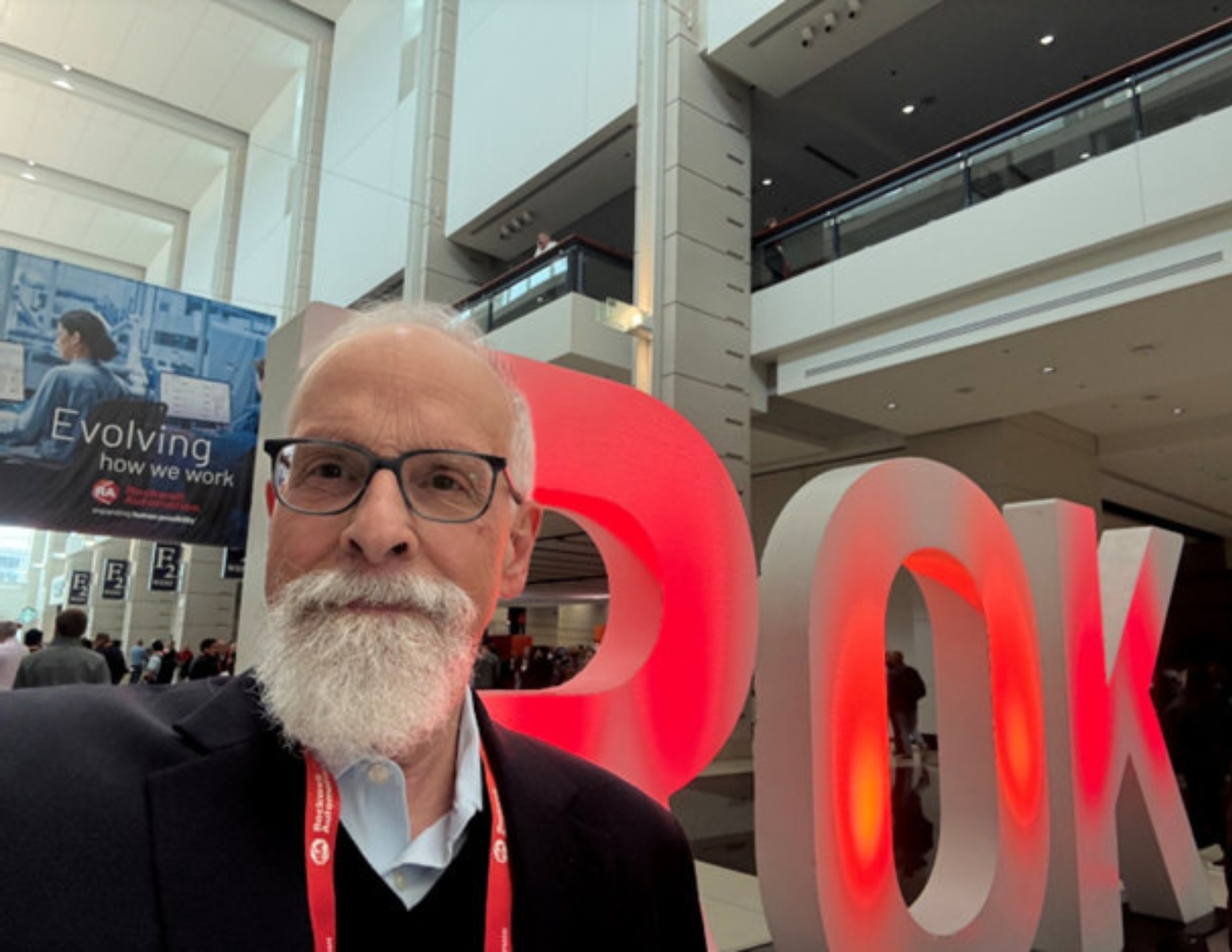


In November, I had the pleasure of returning to Rockwell Automation Fair at McCormick Place in Chicago, typically one of the last vendor conferences of the calendar year. At the event, Rockwell offered training classes, presentations, workshops, and a vendor expo. They highlighted, among other topics, digital twins, elastic MES, AI, and software-defined automation as key technologies for transforming the manufacturing industry.
From the opening keynote by Chairman and CEO Blake Moret, it was clear that Rockwell’s vision embraces cloud, digital twins, and AI as key elements of their technology strategy and future. It was interesting to see how Rockwell has focused significantly more on software since I first started attending Automation Fair a decade ago, and that change appears to be accelerating rapidly.
It was a program as large as McCormick Place. While I can’t cover everything discussed during the multi-day event, I will focus on a few areas that were particularly interesting.
Elastic MES: The next step after configurable and composable

As in previous years, Plex held its own conference-within-a-conference, the Plex Summit, at the start of Automation Fair, prior to the Automation Fair opening Keynote.
Following an initial session that covered Plex’s growth over the past year and customer successes, the Plex team introduced the concept of “Elastic MES”. As MES is “the operational backbone of the modern plant” (as demonstrated by the continued interest in a three-letter acronym that is nearly thirty-five years old), it has also undergone a number of evolutionary changes. MES has evolved from homegrown, hard-coded behemoths to so-called “COTS” (commercial off-the-shelf) solutions that required significant customization, to composable MES, which shifted the customization burden from the vendor to the end customer. With this history, I was intrigued by Plex’s concept of “Elastic MES” and what it might mean for manufacturers.
Elastic MES does not refer to ease of implementation; it is an MES that adapts and evolves as it operates. In the words of Mike Hart, Head of Product – Industry Strategy & Growth, “a platform that helps evolve, adapt, and optimize your business in real time.” This is not a single product; it is a systems approach. At the core are industry-specific workflows, data models, rules, and best practices. This is applied across a broad range of business processes, with end-to-end IT/OT integration, aiming to marry Plex’s IT experience with Rockwell Automation’s OT experience.
Elastic MES is extensible, resilient, and interoperable, supporting open integration with other enterprise systems. Elastic MES is delivered on a unified edge-to-cloud architecture. In effect, it is designed to deliver the agility of the cloud without compromising up time on the line. As analysts, we were initially puzzled by Rockwell’s decision to acquire Plex Systems back in 2021. Four years later, there is no question that this acquisition has benefited both Rockwell and Plex, as well as their customers. The promise of Elastic MES and the evolution toward intelligent autonomous operations are key examples.
Resilient Edge-to-Cloud: Future-Ready MES

A crucial component of achieving manufacturing autonomy is resilient edge-to-cloud connectivity. Rockwell has Plex, one of the first cloud-native MES systems, and the FactoryTalk suite, which includes MES on the edge. Their strategy is to bring these two products together and unify their portfolio. As presented by Hayden Foot, Rockwell is extending Plex with a lightweight, resilient edge component called FactoryTalk ResilientEdge. Available in Q1 2026, this will leverage the elasticity of the cloud with the resiliency of the edge. Rockwell claims this capability will enable 24/7 factory operation, as the resilient edge will react if the cloud connection is disrupted and keep IT and OT systems synchronized.
This capability is also valuable for implementing system upgrades. Upgraded components are released to a cloud repository and can be swapped into a Kubernetes cluster in standby mode without disrupting production. The final piece of the resilient edge capability is leveraging FactoryTalk Optics to display Plex MES, automation, and IIoT information to the operator on a single screen.
A decade ago, it was difficult to find a manufacturer that believed moving manufacturing software to the cloud was feasible. Some were concerned about IP protection, some about vendor lock-in, but ALL were concerned about the twin issues of availability and latency. Resilient edge-to-cloud technology, implemented appropriately, addresses both latency and availability once and for all. These new capabilities make cloud manufacturing a reality.
Software-Defined Automation: the IT-ifying of OT

There were six press conferences held specifically for analysts and media: “Transforming Manufacturing from Within”, “AI and Autonomy”, “Cyber Security”, “Sustainability Forum”, “Robotics”, and “Software-Defined Automation”. Of these, Software-Defined Automation (SDA) drew significant attention from many media and analysts, as it represents a continuation of Rockwell Automation’s journey from hardware-centricity to software-centricity.
For anyone coming from a software background, the capabilities introduced in this presentation were not earth-shattering. Yet, in the context of accelerating the evolution of OT, the topic could be viewed as revolutionary. Coming from a background in programming and testing controllers individually, the SDA capabilities presented by Dan DeYoung, Julie Robinson, and Sherman Joshua are potential game-changers.
SDA allows engineers to store all their code in version control systems, so that they can track code seamlessly across tried-and-true IT elements of design, test, and deployment. Code that is documented and under version control can then enable features such as virtual commissioning.
Rockwell pointed out that the SDA is more than just a soft controller; it is changing the way automation is done. Development is done at the component level, tested virtually – including regression testing – and deployed as containerized workloads on the edge. Rockwell also stated that customers can continue to use all the OT tools they currently have. SDA does not require customers to relinquish their investment in Logix, Optics, and other installed OT infrastructure. They also stated that they expect to have Logix on a panel where customers can also run things like machine vision, robotics, and AI, all in one single package.
Rockwell’s new design environment is intentionally designed to enable concurrent development and collaborative design. Engineers across the plant can work on the same project simultaneously. It was designed to support object orientation, which makes sense to automation engineers. Concurrency enables automated regression testing. It also gives engineers the ability to decide where to deploy at the end of the process, since all development is done virtually. In practice, this creates DevOps for automation systems.
Our Take
This is certainly not the Rockwell we knew from back in the day! The culture at Rockwell Automation today is very different from what we saw in the past. They are making huge strides in cloud, edge, robotics, and AI. At the same time, they are honoring their past by providing a path forward so their customers can leverage, rather than lose, their investments in Rockwell equipment and software. I can’t wait to see what 2026 brings.
Thanks
Thanks to Michael Kane and Kristen Kubesh for the invitation and for coordinating to help me make the most of my time. I’d also like to thank Mike Kane and Michael Hart for taking the time for an in-depth conversation about Rockwell’s MES direction.