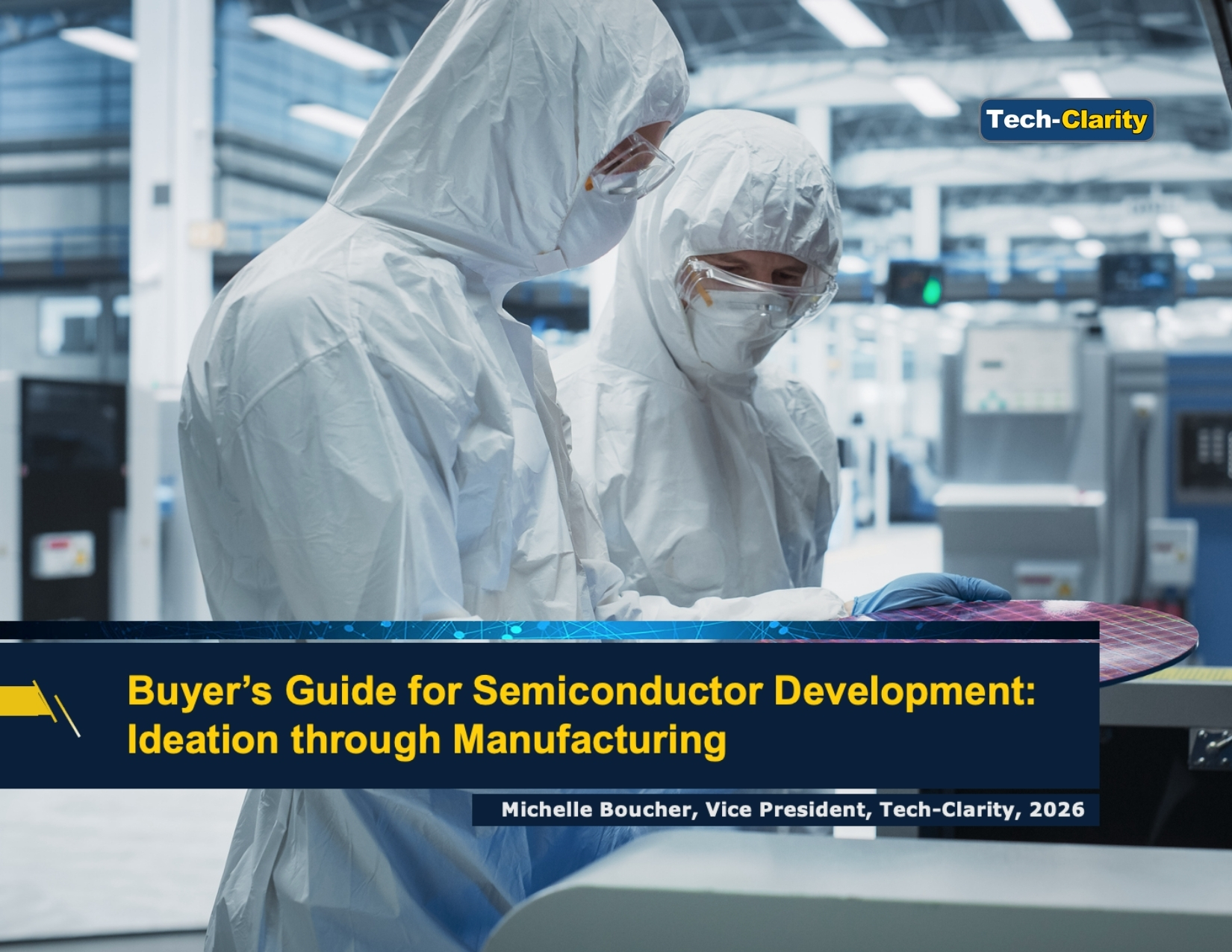

 If you are in the semiconductor industry, do you have the right development and manufacturing solution to scale the business to meet growing demand?
The semiconductor industry is entering a period of rapid growth, driven by AI, electric vehicles, autonomous systems, industrial connectivity, and rising data demands. To capitalize on this opportunity, semiconductor companies must scale to meet growing demand.
Yet, nearly all semiconductor companies report challenges with New Product Introduction (NPI), often caused by disconnected processes, limited visibility, and tools that don’t scale. Top Performers are addressing these issues by investing in digitalization and adopting PLM platforms tailored for semiconductor development. What should semiconductor companies consider to select the right solution?
Based on a survey of 207 semiconductor and high-tech professionals, the Buyer’s Guide for Semiconductor Development: Ideation through Manufacturing outlines key buying criteria across four critical areas: software functionality, service and implementation support, vendor capabilities, and company-specific needs. Based on expert interviews and survey research, it’s designed to help semiconductor leaders evaluate solutions to invest in the tools that will support scalable, profitable growth.
Please enjoy the summary* below. For the full research, please visit our sponsor, Siemens (registration required).
To learn more about the business value of investing in development and manufacturing processes, read our survey-based research report, Three Ways Semiconductor Companies Can Prepare for Profitable Growth.
Table of Contents
- Executive Overview
- Empowering Growth
- Overcome Data and Process Management Challenges
- Ideal Development Solution for Semiconductor
- Use an Effective Semiconductor Data Model
- Leverage the Data Model with the Right Capabilities
- Manage Lifecycle Processes
- Implementation Requirements
- Vendor Requirements
- Identify Unique Company Need
- Conclusions
- Recommendations
- Acknowledgments
- About the Author
Executive Overview
The semiconductor industry is poised for significant growth, fueled by advancements in artificial intelligence (AI), investments in electric vehicles, innovations in autonomous driving, enhanced industrial connectivity, and the rising demand for data storage. This is creating substantial opportunities for the sector, which is reflected in the impressive 19% year-over-year increase in semiconductor global sales in 2024. This double-digit growth is expected to continue as forecasts project that the market could soar to $1 trillion by 2030.
To capitalize on this momentum, semiconductor companies are expanding into new markets, diversifying portfolios, and accelerating time to market. To succeed with these goals, they will need to build on their existing expertise and scale their operations. Top Performing semiconductor companies are supporting their growth by adopting Product Lifecycle Management (PLM) solutions, advancing digitalization, and improving process efficiency.
Yet, growth comes with challenges. Nearly all surveyed semiconductor companies (99%) report difficulties with New Product Introduction (NPI). Additionally, customer expectations for faster NPI and high-quality products have increased since 2020. Many struggle with disconnected processes, limited visibility, and solutions that don’t scale, placing the burden on internal teams. The right PLM platform, tailored for the semiconductor industry, can help businesses overcome these challenges, while empowering them to achieve their goals.
This buyer’s guide outlines the capabilities needed in a PLM solution tailored for semiconductor development. It includes checklists across four areas: software functionality, services, vendor attributes, and company-specific needs (Figure 1). Insights are drawn from a survey of 207 semiconductor and high-tech professionals on the tools and approaches that drive the most business value.

Empowering Growth
To stay profitable over the next five years, semiconductor companies are targeting new industries, expanding product portfolios, accelerating time to market, boosting innovation, and evolving their operational models (see graph).

By diversifying into different industries and broadening their portfolios, semiconductor companies can adapt their existing expertise and innovations for new applications and high-growth areas that require specialized chips like AI, electric vehicles, and autonomous driving. Not only does this open new revenue streams, but it also reduces development costs and improves margins. It also helps offset demand shifts, such as slowing mobile phone sales.
However, managing multiple product lines adds complexity, necessitating efficient processes to encourage reuse and streamline development. Improving how they manage and integrate data can help.
Ideal Development Solution for Semiconductor
 To uncover what drives leading performance, Tech-Clarity surveyed 207 semiconductor and high-tech professionals and identified “Top Performers” as the top 25% that outperform their competitors in metrics that indicate business success. These metrics were:
- Revenue growth over the last 24 months
- Profit margin expansion over the previous 24 months
- Percent of sales from new products
- Product cost reduction over the last 24 months
We then focused on what these Top Performers do differently compared to Others to uncover the factors behind their success.
Overall, 91% of respondents agree that a semiconductor-specific integrated ideation-to-manufacturing solution will be useful in solving their NPI challenges. Still, Top Performers place particular importance on it, with 81% rating it as ‘Extremely’ or ‘Very’ useful.
This type of solution provides end-to-end traceability via a digital thread, enabling better efficiency, visibility, and collaboration. Everyone across development and manufacturing can access a single, up-to-date source of truth.
A semiconductor-specific platform, built on an industry-tailored data model, supports unique processes and enables critical advantages like:
- Greater project visibility
- Better risk management
- Enhanced NPI efficiency
This approach helps improve yields, product quality, and revenue. A PLM solution designed for the semiconductor industry supports this by enabling integration, digitalization, and process efficiency—laying the foundation for sustainable, profitable growth.
Recommendations
Based on industry experience and research for this report, Tech-Clarity offers the following recommendations:
- Plan for long-term growth and scalability across product lines, departments, and engineering silos.
- Use high-level requirements such as those in this guide to evaluate solutions based on business fit before engaging in detailed evaluations.
- Choose a solution that supports the unique workflows of the semiconductor industry.
- Ensure the solution covers all lifecycle stages to support NPI, product and characterization requirements, IP management, technology development, chip design, tapeout and mask management, and BOI and BOP management.
- Invest in digital thread capabilities for end-to-end traceability and efficiency.
- Prioritize integration of design and manufacturing data.
- Address the needs of all roles involved, from concept to manufacturing, to drive adoption.
- Select a vendor with semiconductor expertise who can act as a trusted partner.

*This summary is an abbreviated version of the ebook and does not contain the full content. For the full research, please visit our sponsor, Siemens (registration required).
If you have difficulty obtaining a copy of the research, please contact us.