

How can manufacturers meet customer traceability requirements faster and easier, with a higher level of reliability? Arcstone Advanced MES would argue that using the customer’s choice of LLM AI tool to access the real-time MES and supply chain data in their solution is the answer. Apparently, quite a few automotive components and food and beverage companies would agree, as Arcstone has been growing worldwide in these industries. Arcstone has also added an AI governance tool and a studio for building and governing apps. We recently caught up with founder Willson Deng to learn the latest.
Arcstone’s Vision
The concept behind Arcstone’s offering is that MES at every level is the missing link to achieve real-time, end-to-end supply chain visibility. The company’s stated mission is to provide complete manufacturing transparency across the entire supply chain. CEO Willson Deng states: “By digitalizing and integrating manufacturing operations from the shop floor right to the hands of consumers, we aim to enable a more responsive, responsible, and sustainable manufacturing ecosystem for us all.”
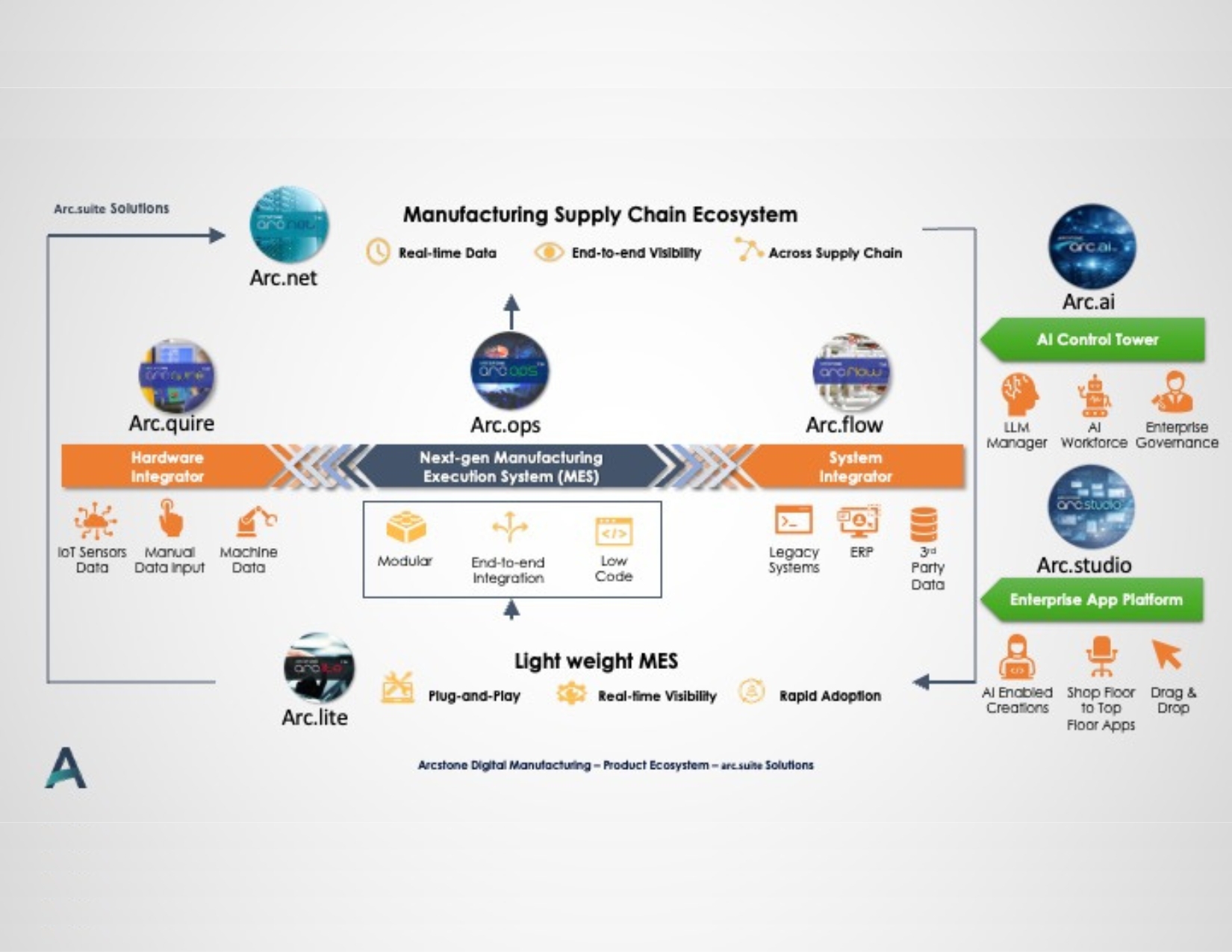
This company offers both MES and supply chain software, aiming to enable even the smallest suppliers to deliver accurate manufacturing data into their ecosystem. We had our first briefing with Arcstone a few years ago; that insight goes into the concept in more detail, lists the product elements, and shows them in a graphic.

Industry Uptake
The company serves many industries, but two in particular have adopted this multi-tier supply chain via MES approach. Precision-engineered automotive parts and components, as well as food and beverage products, have driven excellent worldwide growth for Arcstone.
- Food and beverage companies use supply chain traceability for materials provenance compliance. With real-time visibility, they can reduce the risk of making health-conscious and sustainability claims and focus on capturing demand for high-margin products.
- Automotive tier suppliers’ risk of recalls and product challenges goes even deeper. For them, Arcstone helps address not only regulatory compliance but also the total cost of supporting what you sell. With plant-floor visibility, the risk of misidentifying the root cause of problems is lower. Real-time information on each part shipped is the foundation for what Tesla and others call supplier “Grade A” traceability. So, this approach can improve both top-line revenue and bottom-line margin while reducing maintenance costs.
Both industries face significant risk from faulty materials in their products and are thus regulated accordingly. Automotive parts and food and beverage are highly competitive. They can both capture more or higher-margin revenue with better traceability.
Move to MCP for AI Access & Implementation Speed
Every conversation about software these days touches on AI. Arcstone’s focus is not on creating new tools, but on ensuring companies have protection when accessing actual manufacturing data from their software. Operations people spend plenty of time seeking data, and Arcstone created an MCP interface to enable any LLM or third-party system to read and interpret data across their own enterprise and their suppliers’, customers’, and partners’ systems. It has also created a manufacturing assistant agent that makes it easier to leverage data from the plant floor.
Exposing the Arcstone MES and supply chain systems’ data across the ecosystem has also made it easier to create integrations. An MES-to-ERP integration is crucial, and rather than the two or three people and a month it can often take, the new AI approach enables it to be handled by one person in a few days. MCP also cuts time by half or more when customizations are used to help ensure the MES matches operating best practices and is adopted by operators, Arcstone says. The Arcstone ecosystem of system integrators (SIs) is finding that this AI approach enables them to focus on customer success and satisfaction with fewer headaches, too.

New arc.ai and arc.studio Capabilities
In a pragmatic yet visionary way, Arcstone has also recently released two new capabilities to support governance in the age of AI and low-code apps.
- The first is arc.ai, an enterprise AI governance platform. It includes a secure model gateway plus an agentic AI control tower for safe, cost-effective AI scaling. This layer helps with access and policies, audit and observability, and cost and usage controls. Arcstone delivers this in a phased manner: starting with SSO/RBAC foundations, then the model gateway, the agent control tower, and finally continuous improvement.
- For enterprise app creation, deployment, and governance of scalable apps, arc.studio delivers a drag-and-drop builder for templates that scale across sites, governance and version control, enterprise integration (including arc.net), a global rollout framework, and plug-in-approved AI services for faster integration.

The Mindset Shift
Deng is a true visionary and continues to offer new insights. One is that the mindset for MES and supply chain must shift from what it can do to how customers can use it. Today, AI can build code to do specific functions. Yet, the complexity of managing manufacturing data and sharing it across a particular enterprise and its supply chain ecosystem is where the fundamental value now lies. This underlying MES capability enables significant efficiency gains, whereas functional improvements and the addition of AI for specific capabilities typically deliver only incremental improvements.
Thus, the Arcstone roadmap is less focused on functionality than on robustness, reliability, and ease of use for SIs to do what they need to do. Arcstone’s focus on architecture and ease of customization is to satisfy the SIs. The SIs are there to help manufacturers learn to use the system, then hand it over to end customers to manage and maintain, with no support beyond what they might need.

Our Take
Arcstone’s vision of end-to-end multi-tier supply chain visibility to the factory floors is a strategic dream for most manufacturers. So is the level of sustainability it could enable. In many industries, being wasteful is more cost-efficient than addressing yield issues at the source. However, as regulations change, we expect to see more uptake of this unusual plant-first approach to supply chain resilience.
As commercial LLMs and AI tools mature, their integrate-what-you-choose approach may also serve them and their customers well. Adding arc.ai appears to lower the risk considerably. It can also help corporate IT as they gain AI expertise and new approaches continue to emerge. When combined with arc.studio for governed apps, the picture starts to make sense, particularly for larger enterprises and their ecosystems.
Arcstone’s partner-first philosophy further differentiates them. While many other MES and supply chain providers seek to perform services or ask customers to do it themselves with low-code or AI approaches, this can create competition with SI partners. Arcstone sees the SIs as the expert human touch that customers want and need for implementation, customization, and ongoing 24×7 support worldwide.
We have been impressed by Arcstone’s vision and approach for years. We look forward to hearing about what comes next.