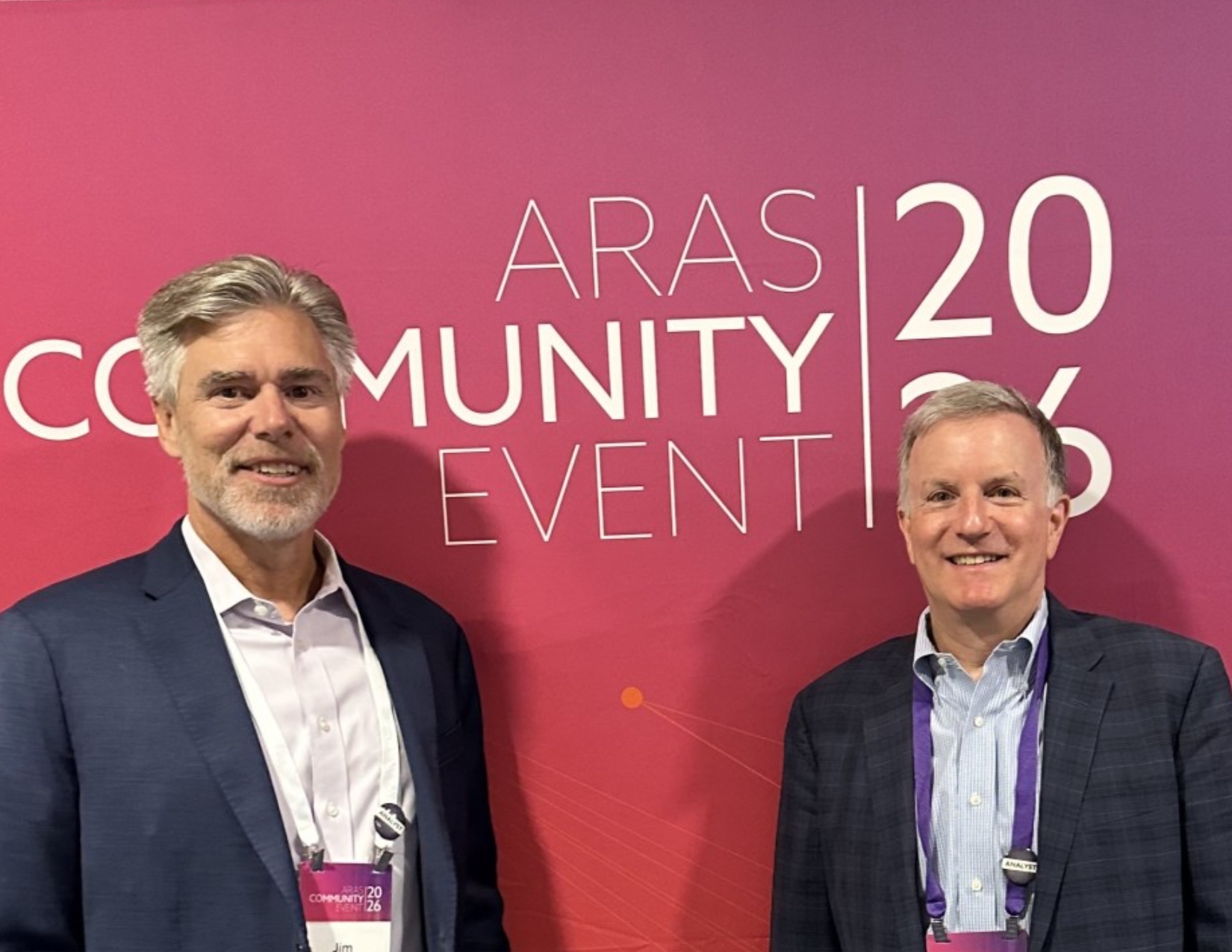


It was exciting to attend my first Aras Corporation ACE User Conference with Jim Brown. The conference was held in Miami, which provided a welcome relief from Boston’s long, cold winter. More importantly, it was great to learn more about Aras’ strategy and products, especially from the Aras leadership team, including their new CEO, Leon Lauritsen. Leon came to Aras with the Minerva PLM acquisition, where he led EMEA sales. Prior to becoming the Aras CEO, he headed the Aras global sales team. His PLM experience, product understanding, and leadership should provide a steady hand as Aras continues to execute on its SaaS and AI strategy.
Our key takeaway is that Aras is building on its core strength as a flexible, extensible, and scalable digital thread platform. The company is moving quickly toward an AI-augmented, agent-based model on a governed, data-centric PLM foundation. We are continually impressed by the level and openness of their community engagement, which Aras considers critical to defining and prioritizing its product roadmap, especially regarding AI. This was evident during the event itself, where discussions consistently centered on what’s working, what could be improved, and how Aras can better support its users.
Aras – A Strong Foundation for AI
In his opening remarks, Leon highlighted that much of the pressure facing manufacturers today comes from rising complexity—across products, regulations, supply chains, and digital systems—combined with the expectation to do more with the same resources. While AI inevitably entered the discussion, we agree with his point that its effectiveness depends on the quality and control of underlying data, reinforcing the continued importance of a strong PLM foundation.
Leon noted that with constant change as the only certainty, flexibility is essential. He believes Aras is well-equipped to address uncertainty with its adaptable, extensible data model and scalable capabilities in workflow management, governance, integration, and performance. We also noted flexibility as a key Aras differentiator in our Aras ACE 2023 Insight, writing, “While most vendors tout standardization and de-customization, Aras encourages customers to leverage the flexibility built into the platform to modify Aras Innovator to support their unique needs.”

At last year’s event, they introduced Aras InnovatorEdge, and since then, they have made significant progress. Aras InnovatorEdge is built on three pillars:
Edge API – Governed Data Gateway to securely expose PLM data and digital thread services to external applications and agents. The Edge API works with both Aras SaaS and On-Prem infrastructure. The API exposes only the necessary data segments for specific use cases, ensuring controlled access.
Edge Builder – SaaS-based ecosystem for building, deploying, and operating task-based apps with native Aras Innovator connectivity. Edge Builder includes a pre-integrated UI framework, a comprehensive component library, and secure authentication. Additional capabilities provided by Edge Builder will further enhance this model, reinforcing the idea that PLM is no longer a monolithic system but a platform that can be extended and adapted at the edges.
Edge AI – A suite of services for building, running, and governing specialized agentic workflows and AI services across the PLM ecosystem. (Aras noted this is coming in Q3, 2026)
Extending the Digital Thread with EDGE Apps

Edge Apps are specialized applications developed using Edge Builder —either built internally or through prebuilt solution accelerators developed by Aras and its partners for industries such as medical devices and high-tech electronics. A no-code Agent Builder allows business users to create and deploy their own agents. This enables rapid development of agent-driven workflows directly within the PLM environment, supported by templates and guided configuration.
Aras introduced their own industry-specific Edge Apps, each targeting a specific use case and pre-configured with data models, workflows, and UI aligned to a given vertical. These include Aras Digital Manufacturing Engineering, Medical Devices, and High-Tech Electronics apps.
Dependency Graphs Underlie Adaptive PLM

Aras introduced dependency graphs that extend beyond simple connections to explicitly identify and model relationships across the digital thread. By mapping these dependencies—even across disparate systems—organizations can automate tasks that were previously manual and often neglected. This unfolds in phases: first building the dependency map, then proposing changes, and finally evaluating downstream impact. The result is a more intelligent, responsive PLM system that can adapt quickly as complexity grows, with many of these capabilities already available in Aras and others rolling out in the near term.
Agentification of PLM

Rob McAveney, Aras CTO, shared a look into the future of Enterprise Software UX. Historically, enterprise software—and PLM in particular—has been built for humans sitting in front of screens, navigating form-based systems and structured workflows. That model is now being challenged. According to Gartner, by 2029, a majority of software will be designed primarily for AI agents, with human interaction becoming secondary. That shift has major implications for PLM: systems will need to support not just human users, but intelligent agents that operate within defined boundaries of governance, security, transparency, and observability. In this model, humans don’t disappear—they guide and oversee—but much of the execution moves to AI. In our industry discussions, API-first architectures are often referred to as “headless” solutions.
The Changing PLM User Experience

Rob noted there are 5 trends shaping Enterprise SW UX:
- Zero UI – traditional interfaces minimized: natural inputs and context take over
- Agent-Centered Design: AI Agents are the new users
- Adaptive UX – hyper-personalized, generative experiences become standard
- UX Democratization: Augmented tools reshape traditional processes
- AI Trust Imperative: transparency is mandatory, limited room for failure
What emerges is a deconstruction of the traditional PLM application hub into a more flexible, agent-driven framework. Work is broken into different kinds —discovering data, enriching it, and amplifying it into decisions and innovation— under an agentic framework. How work gets done now includes conversational interfaces, task-based assistants, autonomous agents, monitoring systems, and collaborative tools. Just as importantly, work is no longer confined to a desktop; it spans mobile devices, tablets, and mobile apps. This “redelegation” happens incrementally: starting with natural language interfaces and chatbots, then evolving into task assistants and monitoring agents that operate more independently. Capabilities like intent-based discovery (from on-demand insights to predictive and even “invisible” discovery), AI-augmented enrichment (such as interpreting requirements documents and feeding structured data into the digital thread), and AI-guided operations begin to reshape how PLM delivers value.
A Good Start: Micro AI Experiences

Rob provided some practical examples of how this may unfold through targeted micro-experiences rather than wholesale system replacement. For example, a simple problem report can start with a photo, with AI automatically populating details and refining them via voice input. A requirements companion app can compare documents against PLM data, identify relationships, and even ingest updates without the user ever entering a traditional PLM interface. Engineers working in CAD can be alerted to issues by monitoring agents, with problems detected “invisibly” and surfaced through conversational prompts.
We believe the path forward is iterative: define the work, determine how and where it should happen, ensure trust, and rapidly deliver a minimum viable product. With a foundation built for adaptability, platforms like Aras Innovator are positioned to support this transition, enabling organizations to move quickly as the shift toward agent-driven PLM accelerates over the next couple of years.
Microsoft – Scaling Agentic AI in PLM

Microsoft is an important Aras partner and customer. At last year’s event, Microsoft shared examples of using AI to extend the value of PLM as a tool to improve people’s efficiency. (see our Aras ACE 2025 Insight). A lot has changed in a year. This year, they shared that Microsoft has an AI-first approach to its business, including its PLM environment (OnePDM), connecting Aras and Microsoft agents. In a multi-agent ECO scenario spanning PLM, engineering, and supply chain systems, Microsoft replaced brittle integrations with agent-to-agent (A2A) communication, allowing agents to interpret data, negotiate across systems, and handle inconsistencies that would typically break traditional integrations. This approach reduced change cycle times from 8 weeks to 2, aiming to reach 2 days, while achieving ~82% accuracy and strong evaluation scores for output quality, task alignment, and business value.
Microsoft found that smaller, task-specific agents—each aligned to a clear function—perform better than monolithic models, and that selecting the right model for each task (e.g., reasoning vs. image recognition) improves outcomes. As they expand toward fully agent-driven PLM workflows, the emphasis is on adaptability, governance, and iterative improvement, recognizing that agent performance will evolve over time with use and refinement.
Our Take
Aras has always stood apart from traditional PLM vendors—both conceptually and technically—which is a big part of its value and why it’s worth evaluating alongside more traditional players. That differentiation continues as Aras strengthens its digital thread capabilities while layering in AI, all without losing focus on its core strengths of flexibility and extensibility.
Under Leon Lauritsen, the company is sharpening that direction through a clear strategy built on market disruption, customer obsession, and people. The approach is to double down on core PLM capabilities, reinforce its unique, adaptable architecture, and extend it with AI—enabling organizations to learn, evolve, and act at speed.
Thank You
Thank you, Leon Lauritsen, Rob McAveney, and Igal Kaptsan, for the business and product updates, and to Josh Epstein, Jason Kasper, Kylie Ochab, and others for insightful conversations and help along the way.