

I had the pleasure of attending the 2026 o9 Solutions aim10x conference in Chicago, my first vendor conference as a Tech-Clarity, Inc. analyst. I have followed o9 as an analyst since the launch of their Digital Brain Platform in 2014, and I took advantage of their invitation to attend their industry analyst day ahead of the main conference. The next day, I joined the customer conference, which featured keynotes, customer and partner presentations, breakout sessions, and lots of opportunities for networking.
The conference was attended by over 500 customers, partners, and market analysts, which is a testament to the growth o9 has experienced in the last decade.
Vision for o9
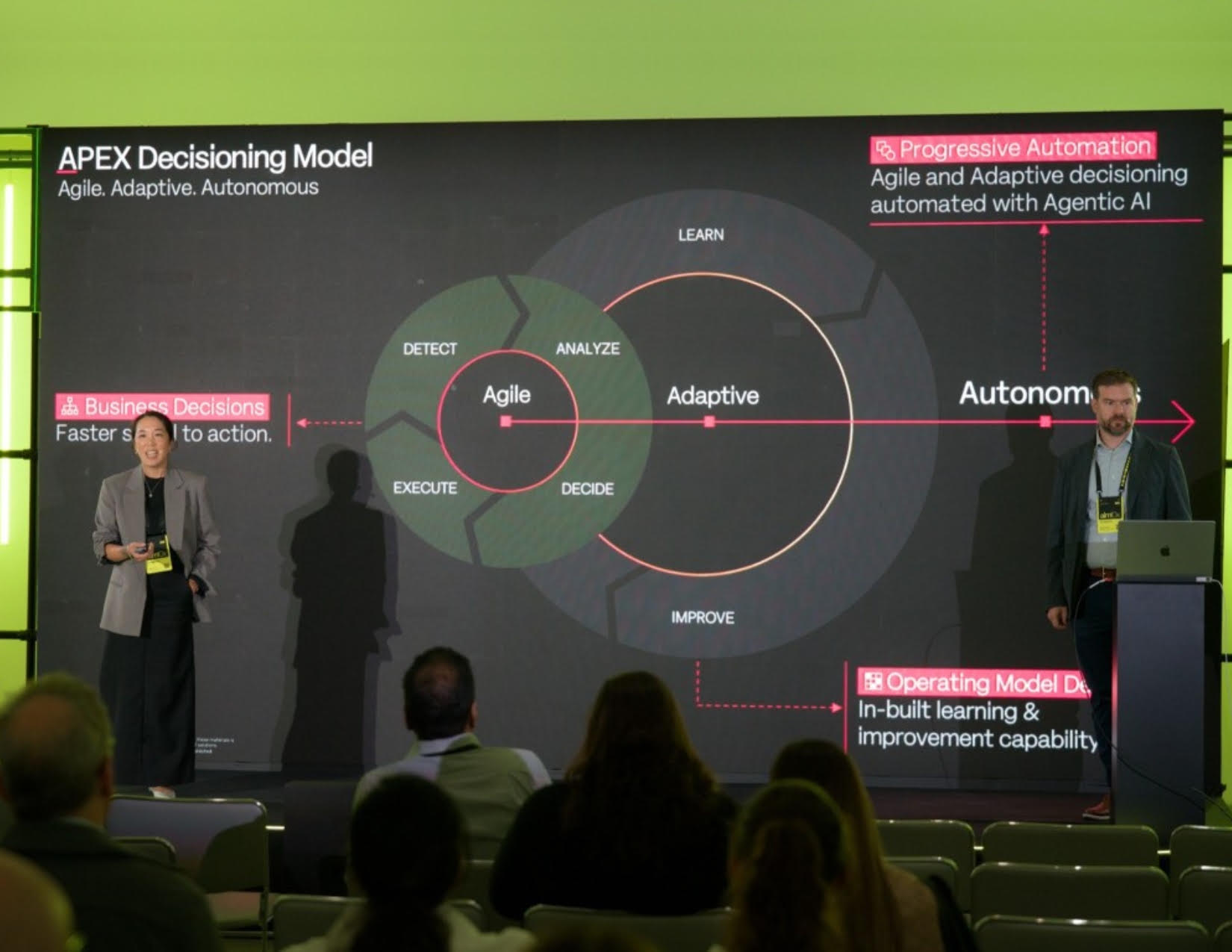
My aim10x experience started with remarks to attendees by CEO and co-founder Chakri Gottemukkala. Chakri introduced o9’s APEX Decisioning Model for enterprise decisioning. The APEX Decisioning Model is built around Agile, Adaptive, Autonomous enterprise decisioning, which represents o9’s intent for supply chains to use the Digital Brain Platform to build and continuously recalibrate forecasts and plans in response to events and disruptions. The Agile capability of APEX has been a long-standing component of the Digital Brain Platform, supporting supply chain operations in detecting disruptions or deviations from plan, analyzing their impact, deciding on the best course of action, and executing that decision.
The Adaptive, the learn-and-improve feedback loop, is a newer component that uses AI techniques to learn from outcomes and, through a feedback loop, refine policies, guardrails, and planning logic. The recently introduced Post Game Analyzer, which I’ll discuss in more detail, is a key element of adaptive learning.
Autonomous Decisioning is the new frontier for o9. The APEX vision relies on its ability to support Agile and Adaptive capabilities at scale, helping companies as they make tens of thousands of supply chain decisions each day. Chakri stressed the importance of agentic AI in the APEX model, focusing on the use of agent-assisted planning to create and evaluate scenarios autonomously, and subsequently make recommendations that are executed autonomously. This is a very ambitious vision that most supply chains are far from realizing due to internal struggles like organizational readiness, lack of visibility into decision interdependence, and data governance challenges.
A Semantic Foundation for Decisions
The hot topic the supply chain market has latched onto is the semantic foundation and decision logic. In turn, o9 has begun building Neuro-symbolic Enterprise Decision Models to capture enterprise context for decision-making. o9’s CTO, Dr. Ashwin Rao, explained the concept of Neuro-symbolic AI to conference attendees in an easy-to-understand way. Neuro-symbolic AI combines the broad intelligence of language models, reasoning, and pattern recognition with the enterprise intelligence of policies, constraints, and decision models. Enterprise semantics are captured in o9’s Enterprise Knowledge Graph (EKG). o9’s EKG has been part of the digital brain platform since its inception. The introduction of their Neuro-symbolic AI Architecture combines neural AI with the symbolic foundation of the EKG, enabling supply chains to incorporate all learning and new findings for each discrete decision into an orchestrated information flow that continually learns and strengthens its foundation.

During my time at aim10x, I had a one-to-one conversation with Chakri, in which he elaborated on o9’s vision for the Neuro-symbolic AI architecture. The vision is to build a library of semantic templates that covers every industry vertical it supports. Companies can integrate the o9 platform with its EKG and Neuro-symbolic AI architecture into their existing tech stack and start from pre-built, industry knowledge models that are then extended and tailored for their enterprise’s needs. Much like industry templates used in supply chain technology implementations, o9’s Neuro-symbolic AI architecture comes predesigned with reusable models, governance structures, and decision frameworks that are tailored to each industry. This is a novel idea and aligns with Chakri’s position that o9 was eventually built to expand beyond the supply chain into other enterprise domains. My view is that o9 is uniquely positioned with its established EKG to make this vision a reality.
Agentic AI
A new product heavily messaged during aim10x is Post Game Analyzer (PGA), billed as a tool to help supply chains compare plans to execution and learn why they diverged, identify points of value leakage, and prioritize transformation initiatives based on measurable impact. It’s a core component of the APEX model. o9 leadership describes PGA as an agentic AI tool, but my observation is that PGA applies agentic techniques within a bounded domain. It investigates and explains, but it doesn’t act across systems or pursue goals autonomously. I’d describe it as an AI-assisted root cause analysis capability with agentic elements rather than as a fully autonomous agent. An open question for buyers is which data sources PGA can draw on beyond o9, and whether it can take action or only recommend.
Speeding Time to Value
A highlight for me was learning about the investments o9 has made in their implementation methodology to ensure faster deployments and rapid time to value. o9 leadership shared examples of customers who collapsed blueprinting timelines and build cycles. As a former consultant, I’ve been on my share of projects with months-long model validation/blueprinting phases and extended build phases, with weeks of scope creep for each build. o9 has taken steps to identify critical-path activities common across customers and has developed methods to rapidly generate documents and pipelines for each new implementation. This is a welcome change and is possible in part due to the use of agents for tasks such as raw data ingestion and data quality analysis.
o9’s leadership team unveiled the updated partner ecosystem strategy called Partner Pulse. o9 works extensively with system integrators (SIs) to support implementation, with many customers choosing to involve a partner in their o9 projects. Partner Pulse is positioned in a way to encourage SI partners to reduce implementation time and improve outcome quality by offering them increased benefits as they demonstrate compliance with the program. My view is that tying benefits to tier progression has the potential to strengthen SI ownership of deployment success.
The combination of o9’s Rapid Mobilization strategy and the SI partner strategy revamp may be a net positive for supply chain technology buyers. The SI and consulting model must change as buyer needs evolve and advancements in software engineering reduce the need for large implementation teams. o9’s approach may be the forcing factor that pushes supply chain SIs and consultancies not just to reevaluate their operating model, but fundamentally change how they engage with their technology partners and add more value for their shared clients.
Customer Stories on Display
The aim10x event affords plenty of opportunities to hear from o9 customers about their digital supply chain journeys. I attended a session by Hormel, a food processing company, which has deployed several capabilities on The Digital Brain Platform since early 2025. Hormel’s message to attendees is that their digital transformation success depends on functional champions who are described as uniquely positioned leaders who are close enough to the business to have end-user buy-in and enough clout with leadership to calm concerns. This sounds somewhat similar to having an executive sponsor whose credibility with executors and stakeholders drives executive buy-in and user adoption.
Another great customer story was WHOOP, a wearable technology manufacturer. WHOOP’s supply chain planning organization is relatively new but is quickly expanding into an end-to-end, decision-focused domain spanning IBP to MRP. Their key to success were:
- People first: reimagining how planners would take ownership of decisions
- Process second: building an operating model to streamline and scale decision-making
- Technology third: choosing a technology partner focused on solving problem statements
WHOOP’s ethos recognizes that technology is not the primary tool for improving its operations, but rather a supporting player that extracts additional value from people and process transformations.

Our Take
The o9 aim10x customer conference has grown considerably since I last attended 10 years ago. And the strategies employed by o9’s leadership aim to ensure that momentum continues. o9’s vision for building on their EKG with a Neuro-symbolic AI architecture holds great promise. Building a semantic layer that spans the enterprise may help the o9 founders realize their vision of expanding o9 beyond their supply chain. Promoting Dr. Aswhin Rao to CTO given his background in applied AI and mathematics, signals to the market that o9’s technology strategy will center on AI and math for decision-making under uncertainty.
Implementation speed and consistency matter to every buyer of supply chain planning technology, and o9 is addressing both. Rapid Mobilization and Partner Pulse strategies could be the missing piece for systemic consistency in implementation delivery, reducing time to value for customers.
Thank You
Special thanks to the o9 analyst relations team, Richa Handa, and Jaimin Gautam, for extending an invitation to Tech-Clarity and managing the logistics of the event. Additional o9ers I had the pleasure of engaging with include Igor Rikalo and Carter Johnson. To the o9 partner team members, Atul Saboo (IBM), Pushpinder Singh (IBM), and Mike Kilgore (EFESO), thank you for the engaging dinner conversations.