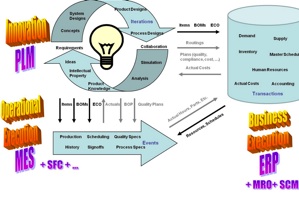

A quick peek into some research on … the role Manufacturing Execution Systems (MES) play alongside ERP and PLM to help manufacturers improve their business and increase product profitability. I have researched, posted, and discussed the complementary and integrated roles of ERP and PLM numerous times.  But the question would come up, “how does MES fits into the picture?” In my graphic I had placeholders for more execution-oriented systems such as MES, Maintenance Repair & Overhaul (MRO), and others. But I made a conscious decision not to complicate the already complicated subject of integrating the manufacturing systems ecosystem. Now that the industry has made progress in understanding how to integrate ERP and PLM, the time has come to address the role of MES. The details can be found in Tech-Clarity Insight: Integrating PLM and MES – Realizing the Digital Factory.
The Research Findings – Preface (or possibly rambling, you be the judge)
For you engineers reading this, do you remember freshman year when they taught you how to calculate stress and strain on rigid bodies? Then as you progressed in your learning, you found out that it was a gross oversimplification and didn’t really apply to real world materials? Or for you brainier people when someone admits that the rules of physics and mathematics are just models that seem to work (for the most part) but aren’t really hard and true rules? Or for business-oriented readers, the first time you heard an accountant ask “what would you like the numbers to be?” instead of giving you a simple answer. I might be digressing a little, so I’ll make my point – sometimes you need to understand the basics without all of the other real-world complexity that makes it hard. But it’s important to get to that real-world understanding, because that is where the real understanding lies. End digression.
The Research Findings – Simplified Roles of ERP and PLM
In my earliest discussions I typically simplified the roles of ERP and PLM as:
- PLM = Innovation
- ERP = Execution
I then progressed that a bit as:
- PLM – PLM focuses on product innovation, and is designed to help manufacturers design, develop, and launch profitable products.
- ERP – ERP’s role is executing the business of manufacturing, supporting the business of planning and managing the execution cycle.
I still like these definitions today, particularly the PLM one. The key difference in the ERP definition is the word “business.” While there are some companies that execute with ERP on the shop floor, for the most part it is used in planning for production and recording the results. Actual production is typically managed outside of ERP. Sometimes it is not automated at all, other times with some form of MES. So the picture was not yet complete.
The Roles of ERP and PLM – Now with MES!
So where does that leave us? With a need to integrate the manufacturing systems ecosystem into the reality of manufacturing operations. This is where MES enters into the picture. I had the opportunity to interview three companies that were willing to share their experience. One is a leading aerospace manufacturer who has significant experience with the integration but unfortunately wasn’t comfortable being identified, one is a Siemens electronics plant, and third is ATK Space Systems. Please read the report for their perspectives, they are worth hearing.
The roles as defined by this report, which are reflected in the updated graphic, are:
- PLM – PLM drives and captures product and process innovation
- MES – MES manages and tracks execution to turn those products into reality
- ERP – ERP manages the commercial business of manufacturing
Still pretty simplistic, I know. But sometimes having simple, clear roles helps companies move their strategy forward. In addition to redefining the roles, the report discusses the following topics in more detail:
- Integrating the product and production lifecycle
- Automating the integrated product and production lifecycle
- Closing the Loop between designs and products
Implications for Manufacturers
I realize this is a long post, there is a lot to say and I have barely scratched the surface of the information in the report. So I will keep this short. Consider the role that MES plays alongside ERP and PLM and take the opportunity to integrate the product and production lifecycle. Whether you call that the “digital factory” or that term means something different to you, examine the value of increasing speed, improving quality, and decreasing errors by developing a synchronized manufacturing backbone that ties innovation, business execution, and manufacturing execution.
So that was a quick peek into some recent research on role that MES plays with ERP and PLM in a manufacturing software strategy, I hope you found it interesting. Does the research reflect your experiences? Do you see it differently? Let us know what it looks like from your perspective. Please feel free to review more free research and white papers about PLM and other enterprise software for manufacturers from Tech-Clarity.
Jim,
my reaction to your article was ‘yes and no’.
Firstly I’d characterise it as
PLM = What (the final product)
MES = How (the steps to create it)
ERP = When and Where (delivery of the resources to follow the How to make the What)
Which is close enough to your definition for now..
So in terms of scope, PLM is Definition, ERP is Execution and MES is a bit of both.
I don’t agree with ‘innovation’ as the PLM ‘word’ though – because the whole thing repeats in service
PLM – end state required after the work
MES – how to do it
ERP – get the resources to do it
It may be that an ‘MRO’ solution handles this variety of PLM/MES/ERP better than a pure (read: manufacturing) variety, but I think PLM wraps around the whole thing and is essential if feedback from operation is to be captured and incorporated in an improved design.
Paul,
Thank you for the considered reply. My reaction to your comment is that “I agree and I disagree.” Maybe we should both be politicians?
Just to be contrary, I will start with where we disagree. I believe that PLM has the capability to plan production processes. With Manufacturing Process Management (MPM), manufacturing engineers have tools to create a Bill of Process (BOP). So the steps to create a product can be (and I would argue should be) more closely tied to the design process in PLM. Then, MES is a great place to localize it and tie it to the controls. I think the process planning can be in PLM (MPM, really). Then, MES can enrich that information with plant-level details. The big question that leaves is where do I store the results? Should that stay in MES as the master? Should it go back into PLM? Should it be in PLM as the master or as reference? That is still somewhat unclear to me, and will likely be a case-by-case decision.
Where we agree is on the “innovation” portion. Innovation happens in all parts of the business. In the graphic I think I am more clear that PLM is driving the plan (BOP, Quality plans, Compliance plans, etc.) that should go into MES and ERP, and that the actual results should be coming back into PLM. That aligns better to your “PLM – What” comment. I have considered changing the “innovation” term but in the end have stayed with it, but I recognize that it isn’t perfect. Thanks for the nudge to make me give it some more thought.
Thanks for the discussion, this is not a simple concept and I appreciate you sharing your perspective.
Best,
Jim
Jim,nnmy reaction to your article was ‘yes and no’. nnFirstly I’d characterise it as nPLM = What (the final product)nMES = How (the steps to create it)nERP = When and Where (delivery of the resources to follow the How to make the What)nnWhich is close enough to your definition for now..nnSo in terms of scope, PLM is Definition, ERP is Execution and MES is a bit of both.nnnI don’t agree with ‘innovation’ as the PLM ‘word’ though – because the whole thing repeats in servicennPLM – end state required after the worknMES – how to do itnERP – get the resources to do itnnIt may be that an ‘MRO’ solution handles this variety of PLM/MES/ERP better than a pure (read: manufacturing) variety, but I think PLM wraps around the whole thing and is essential if feedback from operation is to be captured and incorporated in an improved design.
Paul,nThank you for the considered reply. My reaction to your comment is that “I agree and I disagree.” Maybe we should both be politicians?nnJust to be contrary, I will start with where we disagree. I believe that PLM has the capability to plan production processes. With Manufacturing Process Management (MPM), manufacturing engineers have tools to create a Bill of Process (BOP). So the steps to create a product can be (and I would argue should be) more closely tied to the design process in PLM. Then, MES is a great place to localize it and tie it to the controls. I think the process planning can be in PLM (MPM, really). Then, MES can enrich that information with plant-level details. The big question that leaves is where do I store the results? Should that stay in MES as the master? Should it go back into PLM? Should it be in PLM as the master or as reference? That is still somewhat unclear to me, and will likely be a case-by-case decision.nnWhere we agree is on the “innovation” portion. Innovation happens in all parts of the business. In the graphic I think I am more clear that PLM is driving the plan (BOP, Quality plans, Compliance plans, etc.) that should go into MES and ERP, and that the actual results should be coming back into PLM. That aligns better to your “PLM – What” comment. I have considered changing the “innovation” term but in the end have stayed with it, but I recognize that it isn’t perfect. Thanks for the nudge to make me give it some more thought.nnThanks for the discussion, this is not a simple concept and I appreciate you sharing your perspective.nnBest,nJim
“PLM – PLM focuses on product innovation, and is designed to help manufacturers design, develop, and launch profitable products.”
Going by your above definition, is the name “PLM” misleading? The name “PLM” seems to encompass the entire lifecycle of the product while in reality it often stops at the engineering department.
Satish,
Thank you for your comment.
First – yes, I believe “PLM” is misleading and many people get hung up on the “lifecycle” part of it. They start thinking about product retirement, cannibalization, and more pure “lifecycle” issues. So I try to get people to focus on managing products – not product lifecycles. It’s funny you mention it, that is #1 in my list of “The Ten Myths of PLM” presentation.
Having said that – PLM does have a lot of applicability in later stages of the lifecycle including service. It can also help manage change throughout the life of the product, and help manage critical issues like quality and compliance (which are again lifecycle issues). But, as you say, many PLM implementations stop at Engineering. In fact, many are only Product Data Management or even Engineering Data Management implementations. That is where the systems started, and that is a big part of the value proposition.
So – Given those two answers, I feel like I should amend what I said so that:
“PLM focuses on product innovation, and is designed to help manufacturers design, develop, launch, and MANAGE profitable products.”
Fair enough? Thanks for pointing it out, I have used that description from my ERP-PLM integration papers for a long time and it was helpful to take a fresh look at it.
Best,
Jim
“PLM u2013 PLM focuses on product innovation, and is designed to help manufacturers design, develop, and launch profitable products.”nnGoing by your above definition, is the name “PLM” misleading? The name “PLM” seems to encompass the entire lifecycle of the product while in reality it often stops at the engineering department.n
Satish,nThank you for your comment.nnFirst – yes, I believe “PLM” is misleading and many people get hung up on the “lifecycle” part of it. They start thinking about product retirement, cannibalization, and more pure “lifecycle” issues. So I try to get people to focus on managing products – not product lifecycles. It’s funny you mention it, that is #1 in my list of “The Ten Myths of PLM” presentation.nnHaving said that – PLM does have a lot of applicability in later stages of the lifecycle including service. It can also help manage change throughout the life of the product, and help manage critical issues like quality and compliance (which are again lifecycle issues). But, as you say, many PLM implementations stop at Engineering. In fact, many are only Product Data Management or even Engineering Data Management implementations. That is where the systems started, and that is a big part of the value proposition.nnSo – Given those two answers, I feel like I should amend what I said so that:nn”PLM focuses on product innovation, and is designed to help manufacturers design, develop, launch, and MANAGE profitable products.”nnFair enough? Thanks for pointing it out, I have used that description from my ERP-PLM integration papers for a long time and it was helpful to take a fresh look at it.nnBest,nJim
Hello Jim,
Where can i find the “report for their [Siemens, ATK Space Systems, and aerospace manufacturer] perspectives” you are talking about in the article?
Thanks
Julien,
You can access the report here: http://tech-clarity.com/overviews/mes_plm_erp.htm
It is linked in the article above as well, sorry it wasn’t clear where to find it.
Let me know what you think when you have taken a look at it. This is a topic I get a lot of interest / discussion on.
Best,
Jim
Hi,
I’m just starting to get information about integration of MES,PLM and ERP and I find it very interesting too. What I’m wondering is how this integration is usually performed in a company. Do they each develop their own internal software that fit with their current inhomogeneous tools (as the “aerospace company” you talked with seams to do) or do they use software designed by a third company? If so, is there a high degree of software customization to fit each customer practices? From my early research i found companies like Solumina (iBaseT software) and Intercim (Pertinence Suite) that seams to answer to that new need of integration. How do they adapt themselves to existant company’s processes, habits and softwares.
Thanks
Hello Jim,
Where can i find the “report for their [Siemens, ATK Space Systems, and aerospace manufacturer] perspectives” you are talking about in the article?
Thanks
Julien,
You can access the report here: http://tech-clarity.com/overviews/mes_plm_erp.htm
It is linked in the article above as well, sorry it wasn’t clear where to find it.
Let me know what you think when you have taken a look at it. This is a topic I get a lot of interest / discussion on.
Best,
Jim
Hi,
I’m just starting to get information about integration of MES,PLM and ERP and I find it very interesting too. What I’m wondering is how this integration is usually performed in a company. Do they each develop their own internal software that fit with their current inhomogeneous tools (as the “aerospace company” you talked with seams to do) or do they use software designed by a third company? If so, is there a high degree of software customization to fit each customer practices? From my early research i found companies like Solumina (iBaseT software) and Intercim (Pertinence Suite) that seams to answer to that new need of integration. How do they adapt themselves to existant company’s processes, habits and softwares.
Thanks