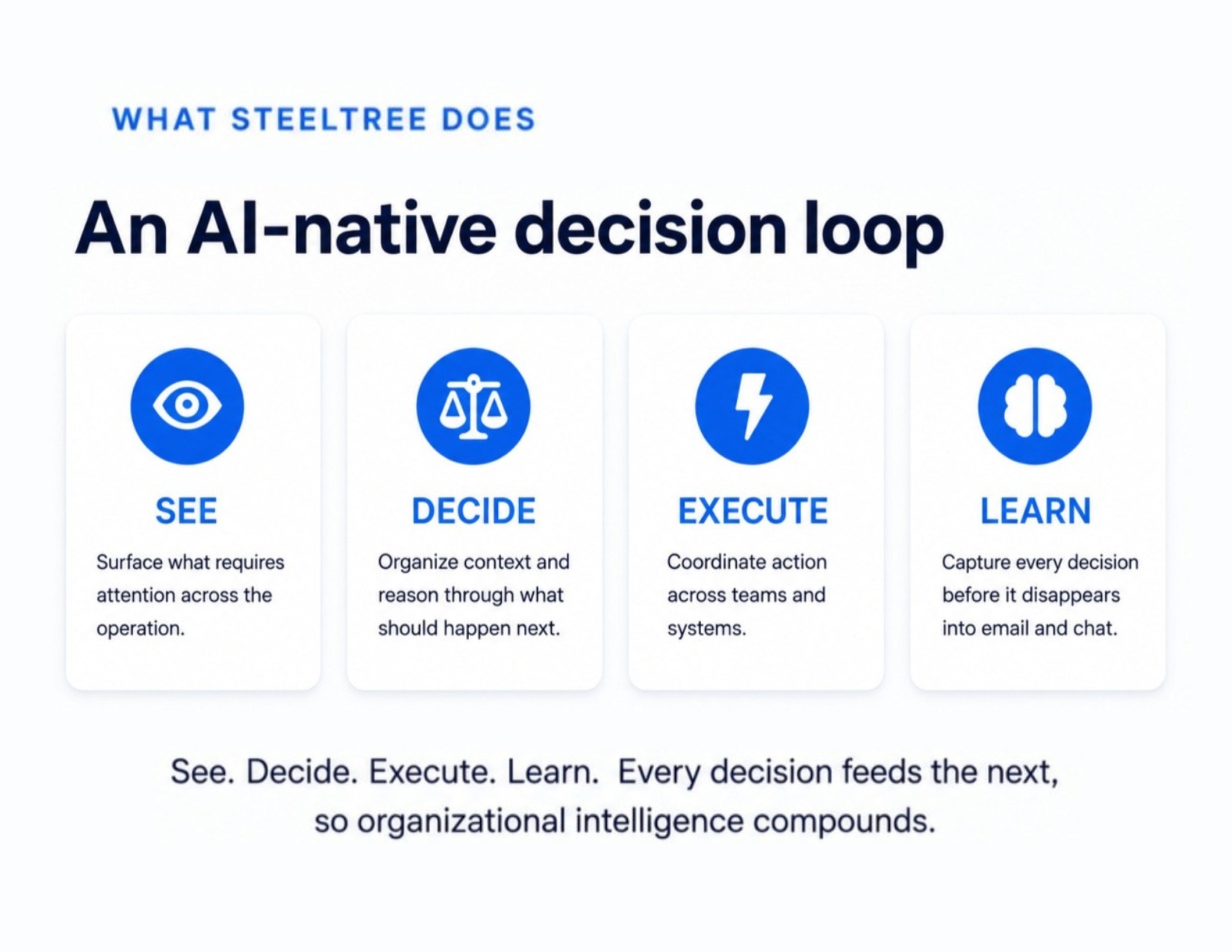


What are traditionally the most frustrating operational activities? According to SteelTree, digging through data and information manually to answer key questions. That assessment is hard to dispute. This startup has built what they call an enterprise-grade Industrial Intelligence layer to sit between physical operations and systems of record. It is intended to surface issues in real-time, capture the why, learn the operation, and live on what exists. SteelTree’s approach progressively builds operational knowledge from the first workflow or operational interaction, with value increasing as adoption expands.
See-Decide-Execute-Learn
What AI adds to an intelligence system can truly shorten the time from information to action that delivers value. The types of questions it’s intended to answer are fundamental, but not easy for most manufacturing operations to answer today:
- What matters right now?
- Why does it matter?
- Who needs to act?
- Did it work?
- What should we remember next time?
These answers are fundamental to effective action in any operation. Yet today, experienced people often work hard and face delays in pulling relevant information. As an AI layer, SteelTree can pull information from an industrial connectivity platform, data historians, PLC tags, systems of record, or collaboration platforms such as Slack or Teams. It uses REST APIs with OData for ease and security of data ingestion.
When these existing data sources are connected, SteelTree can interpret the information from them, and its multi-model AI will continuously monitor conditions and provide accurate answers and recommendations to operations staff as conditions change. It can also close the loop and ensure that the correct action was taken and logged. This can begin to improve the continuous improvement process.
Over time, SteelTree continuously builds a customer-specific model from operational data, documents, conversations, workflows, decisions, actions, and outcomes. This allows operational intelligence to compound over time, making recommendations increasingly contextual and valuable as the organization uses the platform.

Rapid Value
Another area where SteelTree is seeking to change the equation is time-to-value. The starting point is a free sign-up from the website with no credit card, demo, or sales call required. They encourage companies to bring a real problem and a CSV or Excel file of data or pick a use case and try their sample data for maintenance analysis, quality inspection, production monitoring, equipment reliability, shift performance, or safety compliance. They showed us a demo identifying a golden run.
SteelTree is counting on empowering people to gain value immediately rather than spend time up front in sales, selection, integration, implementation, and training. From there, they’ll want to take the next steps and expand use into a paid subscription. This is a consumer model similar to apps on a phone, enabling quick starting points and time-to-value.

Industry Focus
The company’s founders have experience in pulp and paper and other mill products, food and beverage, packaging, chemicals, and oil and gas. They say strong initial engagement is coming from food and beverage manufacturers, in part due to regulatory compliance requirements such as HACCP. Experience in these environments informs both the sample datasets and the overall platform approach, focus, and capabilities.
The SteelTree team has deep experience and sees this offering as appropriate for both small- and medium-sized manufacturers as well as larger enterprises. For smaller companies, the free model, starter datasets, and built-in expertise might open up new horizons for digital value they would not have considered before. For larger companies, SteelTree hopes to ensure people at each facility are involved, not just the corporate or regional teams.

Our Take
We agree that vertical AI for specific industries and their challenges is a good approach. SteelTree’s team has proven experience not just in industry but also in industrial data and AI software, a strong foundation for growing a successful company. Working across existing systems to illuminate day-to-day priorities for operations staff is powerful.
It seems appropriate that the platform builds an increasingly complete and valuable operational knowledge model so customers can gain more value over time. We also see how the free business model, with sample datasets or the ability to upload your own data, has the potential to deliver value rapidly and generate ground-up enthusiasm.
Thank You
We appreciate Lisa Solazzo for setting up the meeting and the founders, Kanwar Arora and Peter Price, for taking the time to explain their experiences, vision, and current stage to Rick Franzosa and me. As SteelTree gains traction and continues to learn, we look forward to updates on your progress.