

Introducing the Topic
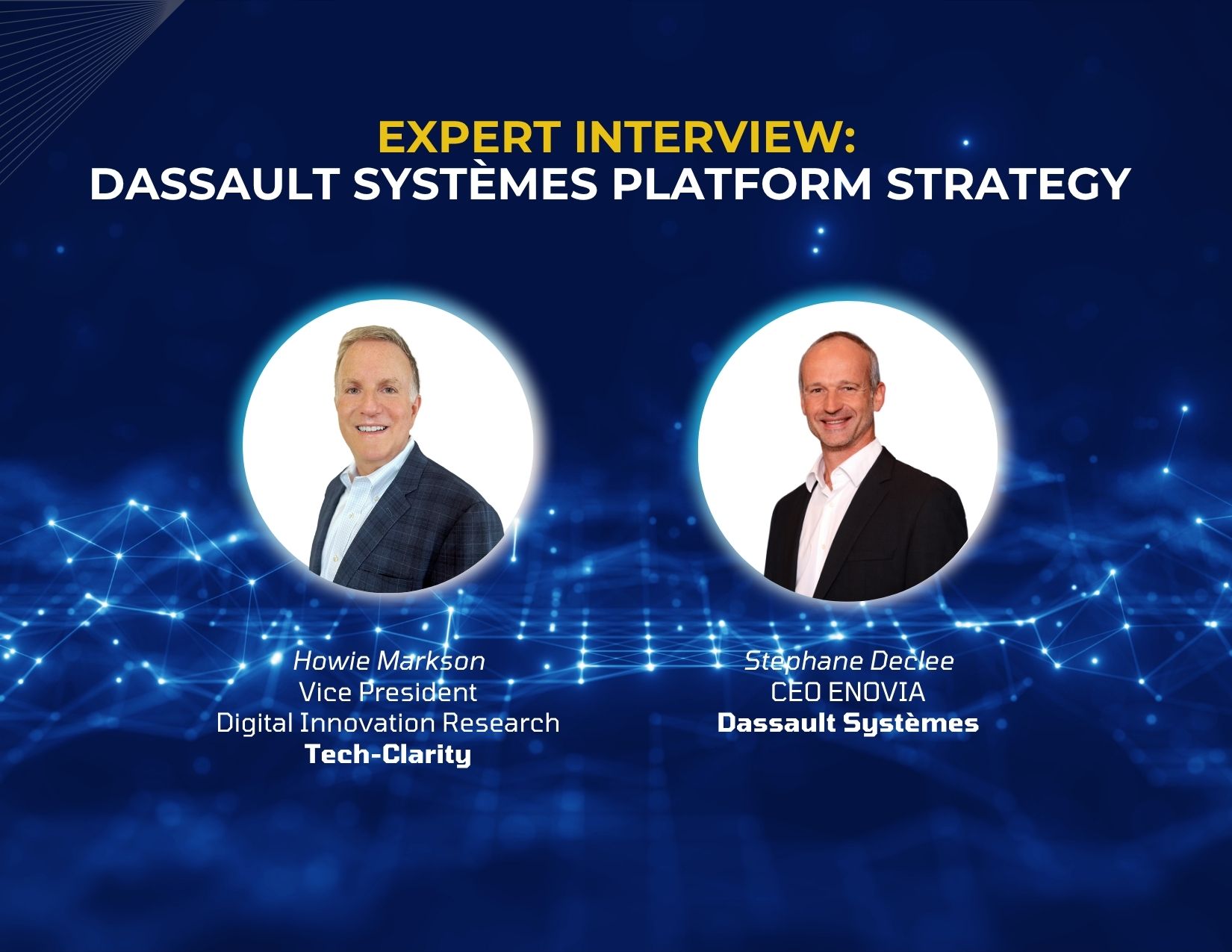
Digital transformation in manufacturing is entering a new phase, as solution providers move beyond traditional PLM offerings toward AI-driven “digital twins” and connected data foundations that promise to make generative AI trustworthy for mission-critical engineering decisions. In this interview, Stephane Declee, CEO of the ENOVIA brand at Dassault Systèmes, discusses how the company is applying decades of industrial knowledge to its platform strategy. Centered on 3D UNIVERSES, the strategy gives manufacturers an industry-specific environment built for a future in which AI plays a central role in product development.
Howie Markson
Hi Stephane. Will you please introduce yourself and tell us a bit about Dassault Systèmes and ENOVIA?
Stephane Declee
I’m Stephane Declee, CEO of the ENOVIA brand at Dassault Systèmes. ENOVIA is the product lifecycle management brand within the 3DEXPERIENCE platform, the place where engineers, project managers, procurement teams, and business stakeholders come together to develop products from concept through production.
Dassault Systèmes has been working with manufacturers for more than 40 years. What’s made us different isn’t just the technology, it’s that we build on deep industrial expertise. We don’t just provide software. We bring scientific models, domain knowledge, and decades of real-world manufacturing experience to every engagement.
Today, we’re focused on something bigger than traditional PLM. We’re helping manufacturers build the foundation they need to operate in what we call the generative economy, where AI-driven design, simulation, and decision-making become practical, trusted tools rather than experimental ideas. That’s the mission behind 3D UNIVERSES, and it’s what gets me up in the morning.
Howie Markson
We’ve been hearing a lot about 3DEXPERIENCE and 3D UNIVERSES lately. Can you describe what 3D UNIVERSES actually is? If someone is running product development at an auto or aerospace manufacturer, what’s in it for them?
Stephane Declee
3D UNIVERSES is a strategic direction, not a single product you buy off the shelf. It’s how we’re evolving the 3DEXPERIENCE platform to serve specific industries in a much more targeted, intelligent way.
For a manufacturer in the automotive or aerospace industry, it means three things in practice.
First, it gives you a living virtual twin of your product, one that connects engineering, manufacturing, operations, and supply chain in a single environment. You’re not working with disconnected files or systems. You’re working with one shared model of truth.
Second, it brings industrial AI into your product development workflows in a way that’s grounded in your company’s actual data, not a generic assistant trained on the public internet. The AI understands your context: your regulations, your design rules, your history.
Third, it helps your people work smarter. Project managers automate the scheduling. Engineers spend more time on design and less on administration. Teams across departments collaborate on the same platform, building and reusing knowledge with every project.
If you’re a vehicle program director or a systems engineer at an aerospace OEM, 3D UNIVERSES is about closing the gap between where product development is today and where it needs to be.
Howie Markson
Most people in the industry refer to digital twins. But you use the term “Virtual Twin” instead. Is that your branding, or is there something fundamentally different between the two? What are manufacturers getting with a Virtual Twin that they’re not getting elsewhere?
Stephane Declee
It’s a fundamental difference, not a branding choice.
A digital twin gives you a snapshot. It captures the current state of a product or asset at a point in time. That’s useful, but it’s largely descriptive; it tells you what exists.
A virtual twin is a living model. It connects every dimension of your product, the geometry, materials, system behavior, manufacturing constraints, and operational data, inside a single platform. It doesn’t just reflect reality; it simulates it. You can test a design change, predict how a system will perform under stress, or anticipate a production bottleneck before anything is physically built.
Here’s a concrete example. A carmaker using a digital twin might capture a static picture of its production line. With a virtual twin on the 3DEXPERIENCE platform, that same manufacturer can simulate the entire production sequence, test different assembly scenarios, identify where bottlenecks will occur, and evaluate design changes all virtually, before committing a single resource.
The other critical distinction is continuous learning. Every simulation, every design iteration, every change feeds back into the virtual twin. The model gets smarter with each cycle. That’s not something a digital twin does. It’s static by design. The virtual twin is dynamic by design.
For auto and aerospace manufacturers working on complex, long-cycle programs, that difference matters enormously.
Howie Markson
Our research on The State of Product Development found that Top Performers are embracing AI in product development. How are you thinking about AI with 3D UNIVERSES? What problems are you solving with it?
Stephane Declee
I want to be honest here, because I think it’s important. When I look at what’s actually deployed at manufacturers today, including large OEMs in automotive, aerospace, and industrial machinery, the real maturity level for AI in product development is still early. There are pilots, there are experiments, but very few companies have put industrial AI to work at scale. The momentum is real, but the realization isn’t there yet for most.
That’s not a criticism. It’s a recognition that the prerequisites are hard.
AI, in a general sense, including natural language interfaces, automation of repetitive tasks, is accessible today. But industrial AI, the kind that actually drives product development decisions, requires something more. It requires trusted data. It requires a model-based, data-driven foundation where the AI understands the engineering context, the regulatory environment, and the company’s own rules.
What we’re building with 3D UNIVERSES is exactly that foundation. We’re not offering a generic chatbot layered on top of your PLM system. We’re enabling generative experiences, AI that operates within your specific industrial context, that can run design scenarios, propose configurations, assess project health, and flag compliance risks with results you can actually act on and trace.
The word I keep coming back to is trustable. Industrial AI at scale has to be trustworthy. That means knowing under what conditions a result was generated, what data fed it, and whether the regulatory environment it was trained on is still current. Without that, you don’t have industrial AI. You have a very capable tool that you can’t rely on when the stakes are high.
Howie Markson
Companies have product data everywhere, in CAD files here, PLM data there, and purchasing data somewhere else. How do you make AI work when all that data is speaking different languages? How does 3D UNIVERSES pull that together?
Stephane Declee
This is exactly the right question to ask, because it’s where most AI initiatives hit a wall.
The first step isn’t technology, it’s ontology. You need a structured model that recognizes your data across systems, aligns definitions, and establishes that a component record in one system is the same entity as a reference in another. Without that, the AI is working with noise.
What 3D UNIVERSES enables is the creation of that data ontology across your enterprise without forcing you to move all your data into a single repository. You’re not doing a massive migration. You’re building a semantic layer that connects your existing assets in an organized, structured way, so AI engines can work across them reliably.
But the real power comes from what you do next. Once your real-world data is properly connected and contextualized, you can combine it with synthetic data generated through simulation, running virtual scenarios that create new data points your physical world hasn’t produced yet. That combination of real and simulated data, projected onto your product and process models, is what makes generative experiences possible.
A designer or engineer isn’t just querying data. They’re running scenarios: what happens if I change this material? What’s the impact on weight, cost, and manufacturing leadtime? The model gives you an answer grounded in your company’s actual knowledge and history, not a generic industry average.
That’s the difference between AI as a search tool and AI as a genuine engineering partner.
Howie Markson
You’ve introduced this concept called IPLM, Intellectual Property Lifecycle Management. Is this replacing PLM, or is this additive to PLM? What’s the main difference for someone managing products day-to-day?
Stephane Declee
IPLM doesn’t replace PLM. It extends it in a direction that PLM was never designed to handle.
Traditional PLM manages a product from conception through to end of life. It tracks what was built, how it changed, and who approved what. That remains essential. It’s not going away.
But here’s what PLM doesn’t manage: the intellectual property, including the design rules, the engineering know-how, the regulatory constraints, and the simulation models used to create that product, which can be reused, recombined, and evolved to create the next one.
With generative AI now capable of producing design configurations, generating product structures, or proposing process changes based on a set of rules, you need a system that manages the lifecycle of those rules and that knowledge, just as rigorously as PLM manages a physical product. That’s IPLM.
A practical example: your AI system generates a structural component design based on current aerospace regulations and your internal stress-testing standards. Six months later, a regulation changes. Without IPLM, you have no reliable way to identify which AI-generated designs are now out of compliance or to re-run those generative experiences with the updated rules.
With IPLM, you can trace every generative output back to the IP that produced it, manage the lifecycle of that IP as regulations evolve, and ensure that the knowledge your teams build today remains a trusted, compounding asset and not an unchecked output you can’t stand behind.
Howie Markson
Change management, BOM management, configuration management, and release processes are core aspects of PLM. What changes occur when manufacturers adopt 3D UNIVERSES? Are they doing these tasks differently, or are they just being integrated into a new system?
Stephane Declee
They’re doing these tasks differently, and that distinction matters.
The 3DEXPERIENCE platform already provides robust capabilities for change, BOM, configuration, and release management. What 3D UNIVERSES adds is a new way of working within those processes: one that combines platform-level collaboration, knowledge reuse, and AI assistance to make each step faster and more intelligent.
Take change management. Today, a change engineer identifies an issue, manually assesses impact, notifies the right people, and works through an approval process that often spans disconnected systems. With 3D UNIVERSES, the same change process is embedded in a collaborative platform where all stakeholders are already working. AI assistance can suggest the right people to include, identify downstream impacts on the BOM or schedule, and help initiate the change workflow automatically.
The same principle applies to configuration management and release. The AI understands the context of your product, its virtual twin, its project status, and its dependencies, so it doesn’t just automate low-value steps. It brings the right knowledge to the surface at the right moment.
What manufacturers are really getting is a platform where the collective knowledge of every project, every change, and every release decision compounds over time. Teams don’t just execute processes in a new system. They work smarter because the system learns alongside them.
Howie Markson
Our soon-to-be-released research shows manufacturers miss project launch dates 45% of the time, and our previous research, How to Reduce Non-Value-Added Work in Engineering, shows that only 54% of an engineer’s time is spent on innovation and actual design work. What are you doing in 3D UNIVERSES that gets engineers back to doing what they love?
Stephane Declee
The numbers are consistent with what we see across our customer base, and they point to the same root cause: too much time spent on coordination, administration, and hunting for information and not enough time on the work that actually creates value.
3D UNIVERSES is built on seven foundations. Without going into all of them, I want to focus on three that directly address productivity for engineers and project teams.
The first is Virtual Companions. These are AI assistants embedded in the platform with full context of your product, your project, and your company’s knowledge. An engineer doesn’t need to search across systems to find a previous design or a simulation result. They ask. The companion understands the context of the virtual twin, surfaces the relevant IP, and can suggest a starting point rooted in what your organization already knows. The engineer takes over from there, refining, shaping, and applying their creative judgment. That’s a very different experience from starting from scratch or copying from an old document.
The second is Generative Experiences. These are structured AI-driven workflows that guide a user through a sequence of intelligent steps. We built an example around project health assessment: today, a project manager copies comments and status updates into an external LLM, runs a sentiment analysis, extracts risks manually, and then creates the risk entries in the PLM system. With 3D UNIVERSES, that entire sequence runs inside the platform in seconds. The companion identifies the risks, proposes the next action, and waits for the project manager to confirm.
The third is Knowledge and Know-How. Every simulation, every design decision, and every change is captured and made available as reusable knowledge. A new engineer on a program doesn’t start with a blank page. They start with the accumulated expertise of everyone who worked on that product before them.
Howie Markson
One thing we hear about 3D UNIVERSES is using virtual twins for products. But what about the organization itself? Can a manufacturer apply these same concepts to optimize its operations?
Stephane Declee
Absolutely, and this is one of the most underappreciated parts of 3D UNIVERSES.
The virtual twin concept doesn’t stop at the product. You can apply exactly the same modeling and simulation approach to the organization itself, including its processes, its methods, its workflows, and its decision-making rituals.
Think about what that means. In traditional operations improvement, you analyze a process, identify inefficiencies, implement a change, and then wait to see the results. With a virtual twin of the organization, you can simulate a process change before you make it. You run the scenarios virtually, identify where the bottlenecks will move, test the new workflow, and then deploy with confidence.
For a manufacturer, this could mean modeling the entire product development process from requirements gathering through engineering, validation, and production launch inside the platform. Every project then runs against that virtual model, learns from what worked and what didn’t, and improves the template for the next program.
It also means that the knowledge your organization builds, such as the way your teams work, the processes that consistently deliver on time, and the practices that don’t, becomes a structured, reusable asset rather than something that lives in someone’s head or in a slide deck. That’s a meaningful competitive advantage, especially as experienced engineers retire and new talent needs to get up to speed quickly.
Howie Markson
Can you give me a real example? A customer who’s using 3D UNIVERSES and seeing results, can you tell us what they were struggling with, and what changed?
Stephane Declee
Automation Express is a great example, and it’s one I find myself returning to often because it shows the full picture.
They’re a small industrial machinery company. They develop around 10 custom machines per year, fully engineered to order, meaning every machine starts with a client conversation rather than a standard catalog. That’s a complex, resource-intensive model for a small team.
Their challenge was scaling. Every new project required significant engineering effort just to define scope, configure requirements, and align sales with production. They didn’t have the bandwidth to grow without either hiring aggressively or fundamentally changing how they work.
What they built with 3D UNIVERSES was a virtual twin of their organization. Every time a new project begins, they don’t start from a blank slate. They replicate a project template, including processes, documents, and requirements structures, that captures everything they’ve learned from every previous machine. Engineering and sales collaborate from day one on the same platform, which dramatically accelerated their time to market and reduced costly misalignments between what was sold and what was manufacturable.
Over time, they also built a rich virtual twin of their products, including all the documentation, supplier data, and maintenance knowledge around each machine. Now they’re preparing to deliver that virtual twin to their customers alongside the physical product. It’s a new value stream they didn’t have before.
The bonus is what comes next: they’re moving toward configure-to-order, using 3D tools that let their sales team configure a machine in front of a client in 3D, potentially in augmented reality on the factory floor, without requiring engineering resources for every configuration. That’s how a small company scales without losing its engineering-to-order identity.
Howie Markson
What do you think people misunderstand about 3D UNIVERSES? What’s the biggest misconception you hear?
Stephane Declee
The biggest misconception is that 3D UNIVERSES is a product, something you buy, deploy, and switch on. It isn’t.
3D UNIVERSES is a strategic direction. It’s how Dassault Systèmes is evolving the 3DEXPERIENCE platform to serve specific industries such as automotive, aerospace, industrial machinery, and others, with the depth of knowledge, AI capability, and integration that those industries need to compete in the next decade.
The second misconception, which follows from the first, is that it’s all-or-nothing. Manufacturers sometimes hear about virtual twins, industrial AI, generative experiences, and IPLM in the same conversation and conclude that this must be a massive, multi-year transformation before they see any value. That’s not how it works.
You start where your pain is greatest. If your engineers are spending too much time on administrative work, you start with virtual companions. If your project teams are missing launch dates, you start with AI-assisted project management. If you’re struggling to scale your engineering-to-order model, you start with configure-to-order tooling.
Each capability builds on the same platform foundation, so the investments compound. The knowledge you capture in one project informs the next. The data ontology you build for one process extends to others. You’re not doing a big bang replacement of everything you have. You’re adding real, practical capabilities in the areas where they deliver the fastest return, and you’re building toward something much more powerful over time.
That’s the approach, and it’s grounded in 40 years of working with the world’s most demanding manufacturers.
Key Takeaways
Thank you, Stephane, for the interview. At its core, 3D UNIVERSES rests on a simple premise. Manufacturers won’t get trustworthy AI in product development until their engineering, manufacturing, and operations data are on a single, connected, continuously updated model rather than scattered across systems. Building a shared ontology and grounding AI in a company’s own contextual data, rather than generic training data, is a good starting point. The small manufacturer example is an early proof point, showing real gains in speed and alignment from a shared platform.
Thank You
Thank you, Kyle Herring, for arranging the interview. It was an informative discussion that should interest manufacturers looking at PLM solution providers and their AI strategies.