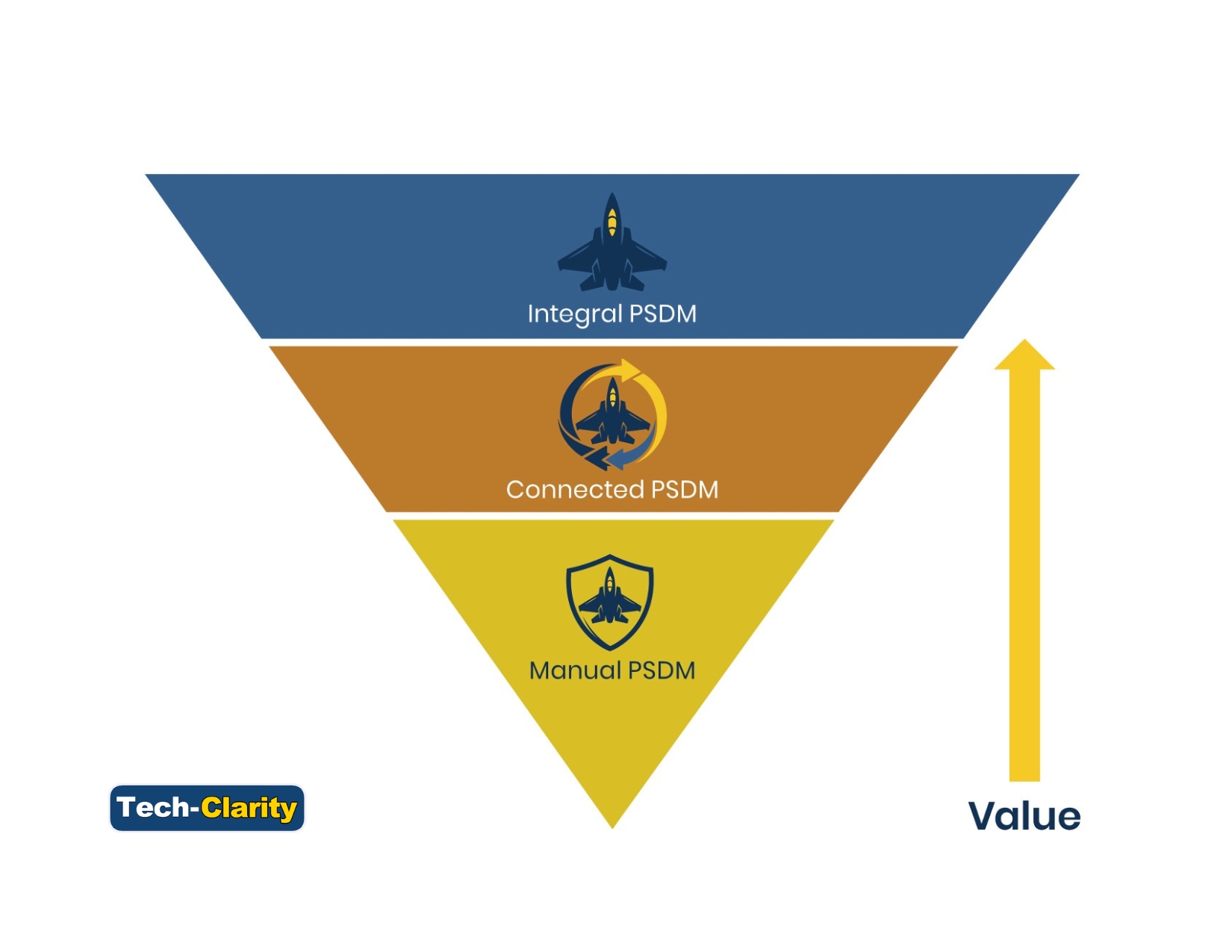

 OEMs spend significant time and effort pulling together data to meet Integrated Product Support (IPS) requirements. Creating and aggregating product sustainment data is inefficient due to disconnected data and processes. How can PLM help OEMs and suppliers develop and capture high quality IPS data to meet standards like SAE GEIA-0007C without creating redundancy and excess cost? How does this approach support a closed loop between engineering and sustainment? We explore three levels of Product Support Data Management (PSDM) maturity ranging from manual approaches to an integral approach leveraging the PLM data model.
Please enjoy an overview of our findings, below. For the full research, please visit our sponsor, Siemens.
Table of Contents
- Executive Summary: Transforming IPS with PLM
- Importance of Support Data
- Manual PSDM
- Connected PSDM
- Integral PSDM
- Integral PSDM in Action
- Extend the Value
- Drive Higher Strategic Value
- Acknowledgments
Executive Summary: Transforming IPS with PLM
 The Critical Role of IPS in Sustainment
The best designed equipment doesn’t fulfill mission objectives if it’s not operational. Mission readiness relies on well-maintained equipment. That may be obvious. But keeping aircraft flying or vehicles rolling can’t come at any cost. Operators must be able to sustain their fleets with an optimal balance of cost and risk.
Service data from the OEM is essential to maintaining this balance. IPS (Integrated Product Support) is essential for providing operators with the information they need to sustain equipment across both military and commercial fleets. For defense contractors, of course, IPS is a mandatory, contractual obligation.
PSDM: Improving IPS with PLM
Today, OEMs and their suppliers are meeting IPS demands through brute force and significant manual effort. Today’s processes are inefficient and costly. This is true for initial IPS database development and delivery, but even more so in the field as equipment is updated through ECOs and MRO activities.
PLM-enabled IPS, or PSDM (Product Support Data Management), provides the support data management processes required for the generation and storage of the data required for standards such as SAE GEIA-0007C.
PLM offers the opportunity to streamline IPS development by connecting data across the digital thread from design through service and improve processes with AI. But managing product support data in a PLM context can do more than just increase efficiency. It can improve sustainment processes and data.
PSDM Maturity
PSDM can bring engineering and logistics data – and engineers – closer together to better design for sustainment and close the loop on service issues. For commercial operations, it can also help drive service profitability.
We see three levels of increasing maturity and value available from PSDM:
- Manual PSDM
- Connected PSDM
- Integral PSDM
Importance of Support Data
Importance of Sustainment
Before we get into the details, why are we talking about improving IPS with PSDM? IPS is a means to an end, achieving equipment readiness and availability at an optimal cost. The goal is to improve maintenance planning, logistics, provisioning, and service execution. As DOD Instruction 5000.91 states, “Effective product support and sustainment depend on disciplined data management, because accurate product support data is fundamental to informed decision-making, readiness outcomes, and lifecycle affordability — a core tenet of DoD acquisition and sustainment policy.”
Sustainment is Data-Driven
OEMs must go beyond designing and producing equipment. They must develop and transfer knowledge to the operator to enable them to sustain the equipment. Sustainment processes also help balance risk by putting RAMS (Reliability, Availability, Maintainability, Safety) analysis results into action. The operator relies on that data to maintain, repair, and upgrade assets effectively.
Helps Operators and OEMs
IPS (see sidebar) is typically a requirement passed from operators to OEMs so they have what they need to drive operational availability. But IPS in PLM, PSDM, can also help OEMs and their suppliers in a variety of other ways. PSDM can help OEMs move from an equipment delivery mindset to a lifecycle support paradigm. This is especially important in contractual scenarios where OEMs are responsible for asset sustainment or where the OEM is strategically targeting downstream profitability. We’ll discuss additional advantages of closing the loop from service to engineering as well.
 Drive Higher Strategic Value
Leverage PSDM Strategically
Sustainment is critical, and service data is mandatory in the defense industry. But the PSDM approach can offer significant strategic value elsewhere. Anyone that operates a fleet needs to know the cost to operate, maintain, and keep assets operational. Integral PSDM based on PLM offers the opportunity to do this more efficiently, put service data under configuration and change control, and close the loop to encourage design for service mindset and workflows. Further, PSDM in a PLM context creates a rich database on which to train AI.
Increase PSDM Maturity
OEMs have the opportunity to drive three distinct levels of PSDM maturity:
- Manual PSDM, which is compliant but cumbersome
- Connected PSDM, integrating PSDM and PLM data from standalone solutions
- Integral PSDM, managing PSDM in PLM to add configuration, lifecycle, and change control
Integral PSDM with PLM, the highest level of maturity, increases efficiency, creates better data, and fosters collaboration. This high maturity approach increases asset availability at optimal cost with the strategic value of collaboration, design for service, and a closed loop between design and service.
 Striving for Integral PSDM
Achieving the highest level of maturity could be viewed as a journey starting with added efficiency using PLM and then better managing configuration and changes to extend the value. Then, OEMs could strive to create a collaborative, closed-loop environment to further extend the value. There may be opportunities, however, for a program to leap multiple levels of maturity at one time without passing through lower levels of maturity. In the end, collaborative, closed loop PSDM is what will differentiate a winning OEM from a compliant one. It moves the conversation from simply delivering a logistics product database to creating a comprehensive digital twin from engineering to service. This value is achievable with PLM and promises significant new value ranging from efficiency to increased service revenue, where applicable.
*This summary is an abbreviated version of the ebook and does not contain the full content. For the full research, please visit our sponsor, Siemens.
If you have difficulty obtaining a copy of the research, please contact us.