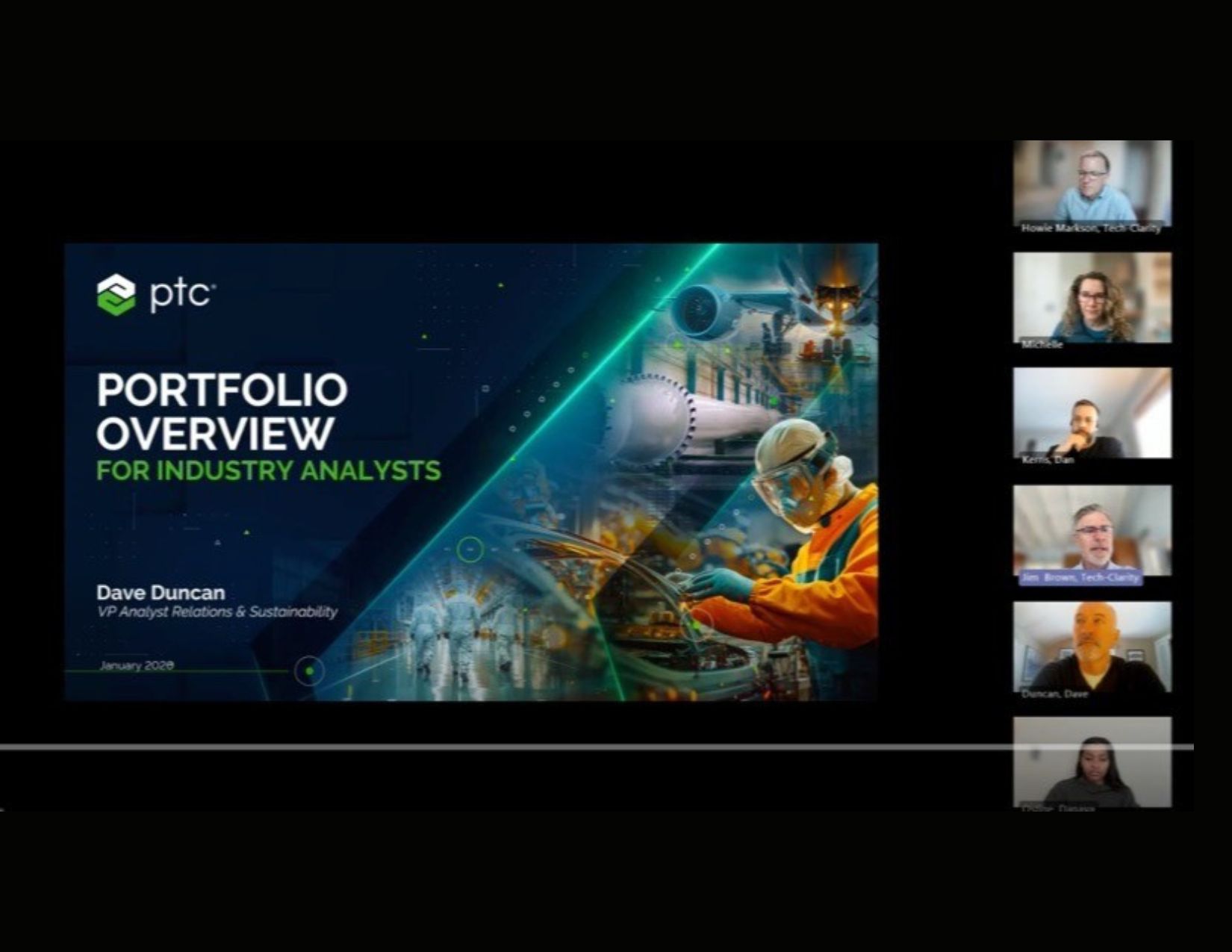


We had the chance to spend some time with PTC leaders recently to discuss their strategy. We’ve followed PTC for over two decades and watched them transform numerous times. They’re currently in a new era under the leadership of CEO Neil Barua , who took over the CEO role several years ago after serving as the CEO of ServiceMax. Our impression from the conversation is that the PTC strategy feels refreshingly focused and leverages their core strengths. We think customers will respond very well to this approach.
PTC’s Core Strengths
Stepping back, what are PTC’s core strengths? PTC started with parametric CAD and has remained strong in the design world, currently with Creo, Onshape, and Creo Elements Direct. They were also one of the earliest PLM companies with their Windchill platform. They have deep roots in these spaces and have continued to innovate and invest over time.
But PTC has also been forward-thinking and pushed the boundaries of what a “PLM” suite should offer. They have consistently looked more broadly beyond engineering, supporting what today we’re all calling the digital thread. Examples of that include expanding to ALM to support product software, Arbortext for product documentation, and Servigistics for SLM. Product data is PTC’s core strength, and their current strategy has “shifted exclusively to product data value.” Given the increasing value of structured data to fuel AI initiatives, we believe this is a solid strategy.
Intelligent Product Lifecycle
The new vision PTC unveiled is IPL, or “Intelligent Product Lifecycle.” Following on their digital thread history, it covers the full product lifecycle from engineering, through manufacturing, operations, service, and sustainment. PTC says IPL is “Powered by product data, fueled by AI.” The strategy leverages both PTC’s broad product portfolio and a belief in openness to connect to product data in adjacent and even competitive systems following an OSLC and other standards-based approaches. An example of openness is Windchill, which has always put a high priority on supporting multiCAD environments. Their open, enterprise-level approach is highly valuable as manufacturers continue to streamline operations and remove product development friction.

Integrated Product Engineering
PTC is also increasing investment in their design capabilities, what they’re calling Integrated Product Engineering, or IPE. The IPE approach consists of orchestration and collaboration across design disciplines. PTC supports this with a collection of the right pieces for today’s complex, software-defined products including the Codebeamer ALM solution to support software-defined products. This gives PTC both mechanical and software design, and they partner with leading ECAD vendors.

Manufacture and Service as Designed
PTC’s strategy extends further down the digital thread and product lifecycle to manufacturing, where they support manufacturing process planning. From there it extends to the service lifecycle and end-of-life. These areas follow the PTC strategy to focus where product data drives value. For example, PTC can offer configuration-specific work instructions for field service or MRO based on the as-designed, as-manufactured, and as-maintained product structures.
Industry Focus
PTC will continue to focus on five markets they feel they can best service because they have what they call “whole product” needs, including software-defined products, safety-critical / regulated industries, serviceable / circular products, and high rates of engineering change. The industries they focus on are:
- Electronics and High-Tech
- Federal, Aerospace, and Defense
- Automotive
- Industrials
- MedTech
Applied AI
Product data also supports PTC’s “Applied AI” strategy. It’s a practical strategy to help their customers gain new value through high value, achievable use cases. PTC has already delivered AI through existing capabilities like shape recognition and topology optimization in CAD. Now, they are using AI in ALM to validate and improve requirements and draft test requirements. In field service, they plan to leverage AI’s ability to gather data from disparate systems to streamline field service through generative data aggregation. PTC will surely extend these capabilities, and we look forward to learning more as they progress. From what I learned from a recent PTC AI in Focus webinar I joined, PTC has been making progress and delivering on a holistic, practical AI strategy.
Looking Ahead
We’re also looking forward to learning more about a new PTC product, Asset360. Asset360 is a product twin that serves as the data hub for physical assets in the field. The Product Twin Is PLM-connected and includes fielded asset configuration and activity data.
PTC also made a strategic decision to divest Kepware and ThingWorx. The capabilities were intended to further PTC’s “smart connected products” strategy, but their IoT capabilities gained traction on factory equipment around the product being manufactured, rather than on the products themselves. Divesting Kepware and ThingWorx closes that chapter and allows PTC to focus more squarely on product-centric capabilities versus manufacturing asset-centric functionality.
Accelerated by SaaS
Lastly, it’s important to mention PTC’s SaaS strategy with “Plus” offerings for Creo, Windchill, and Codebeamer. This is in addition to cloud-native solutions Onshape and Arena. Today, PTC focuses Onshape on smaller companies and Arena on fast-moving products like electronics, what we would call supply-chain-centric versus engineering-centric manufacturers. They also have their FlexPLM solution for footwear and apparel. These solutions aren’t being force-fit into the IPL strategy, which allows PTC to focus on their core capabilities.
Thank You
We expect a continued positive reaction to the focus from their customers and we’re excited to follow their progress. Thank you to PTC’s Danaya Ostine, Dan Kerns, and Dave Duncan for your time sharing your vision with our analyst team. Thank you to Tech-Clarity’s Michelle Boucher, Howie Markson, and Julie Fraser for joining the briefing and providing input to this post.